
Last updated August 25, 2026
Free on-site gate assessment - hinges, posts, and your LiftMaster or Nice gate operator checked before anything is quoted
The assessment is free and the quote is the invoice.


 Before
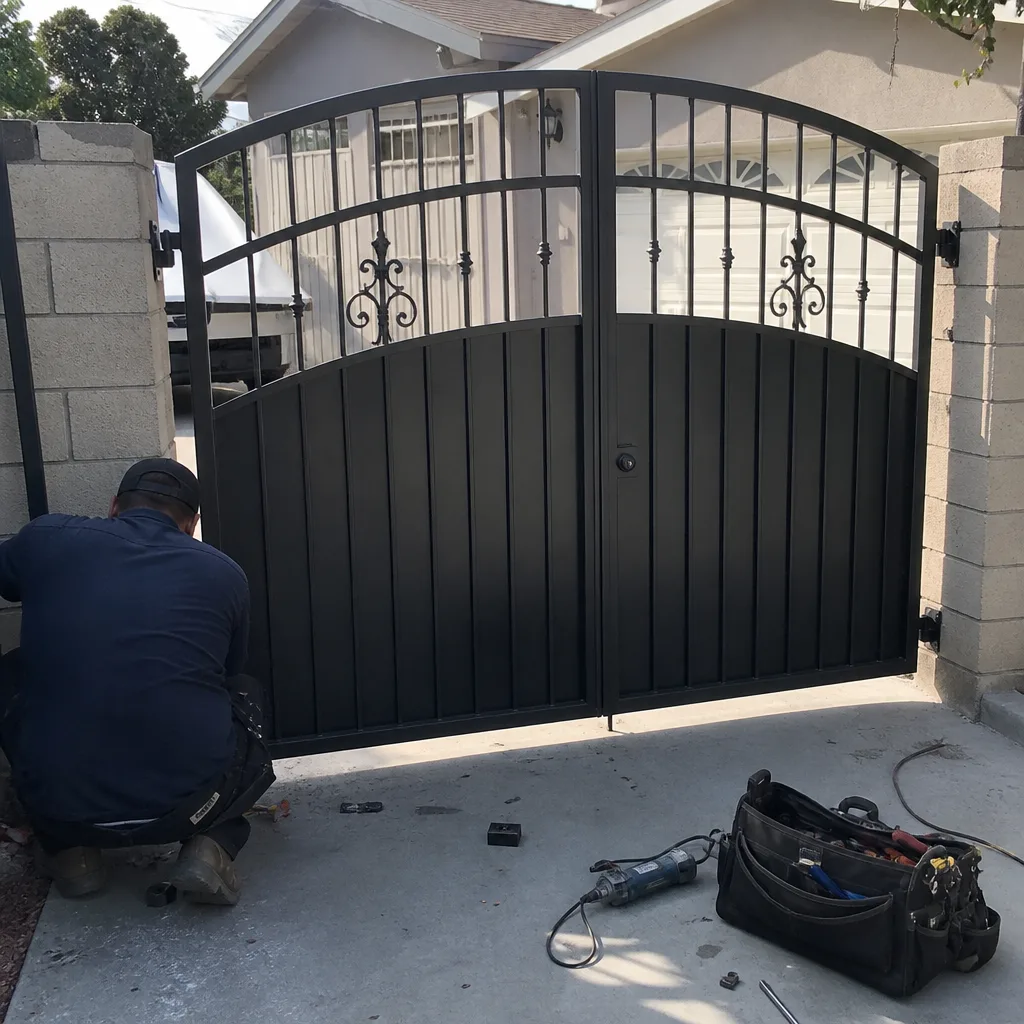 After
After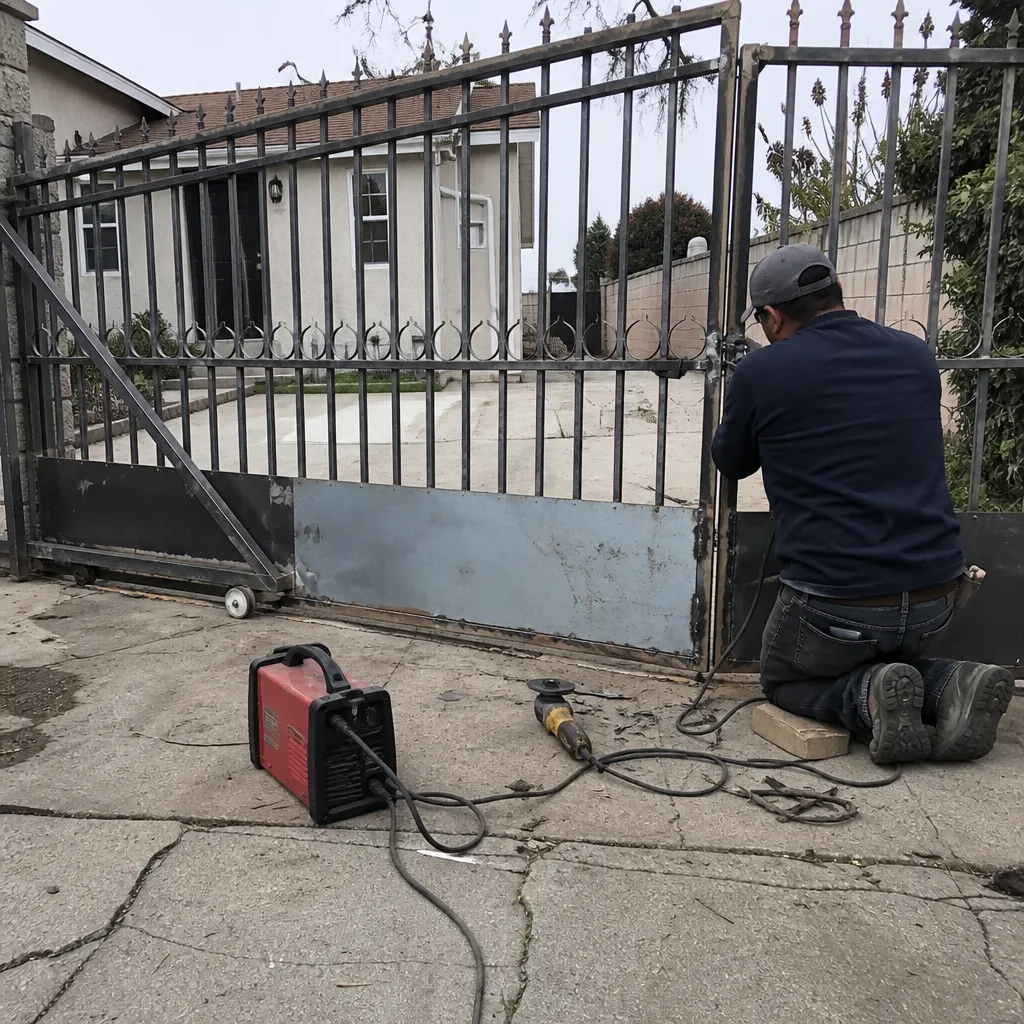 Before
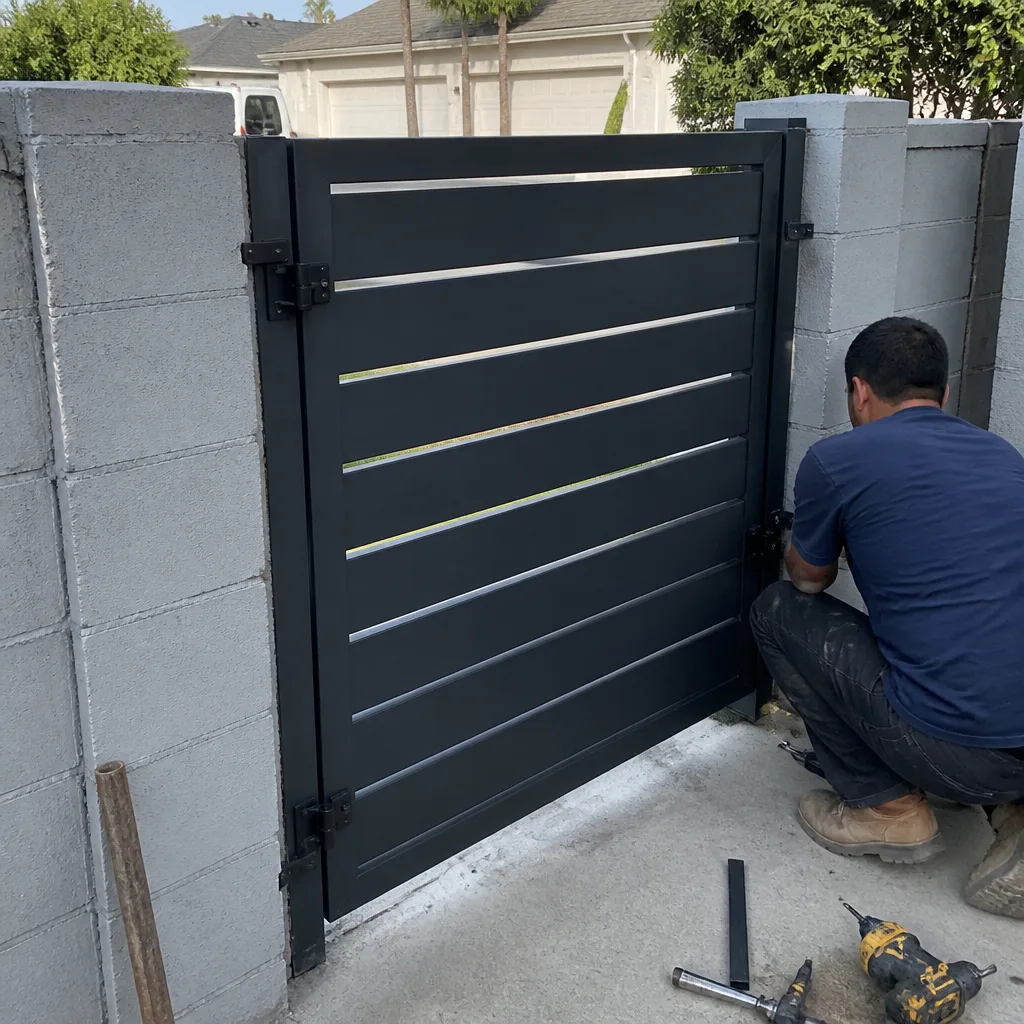 After
After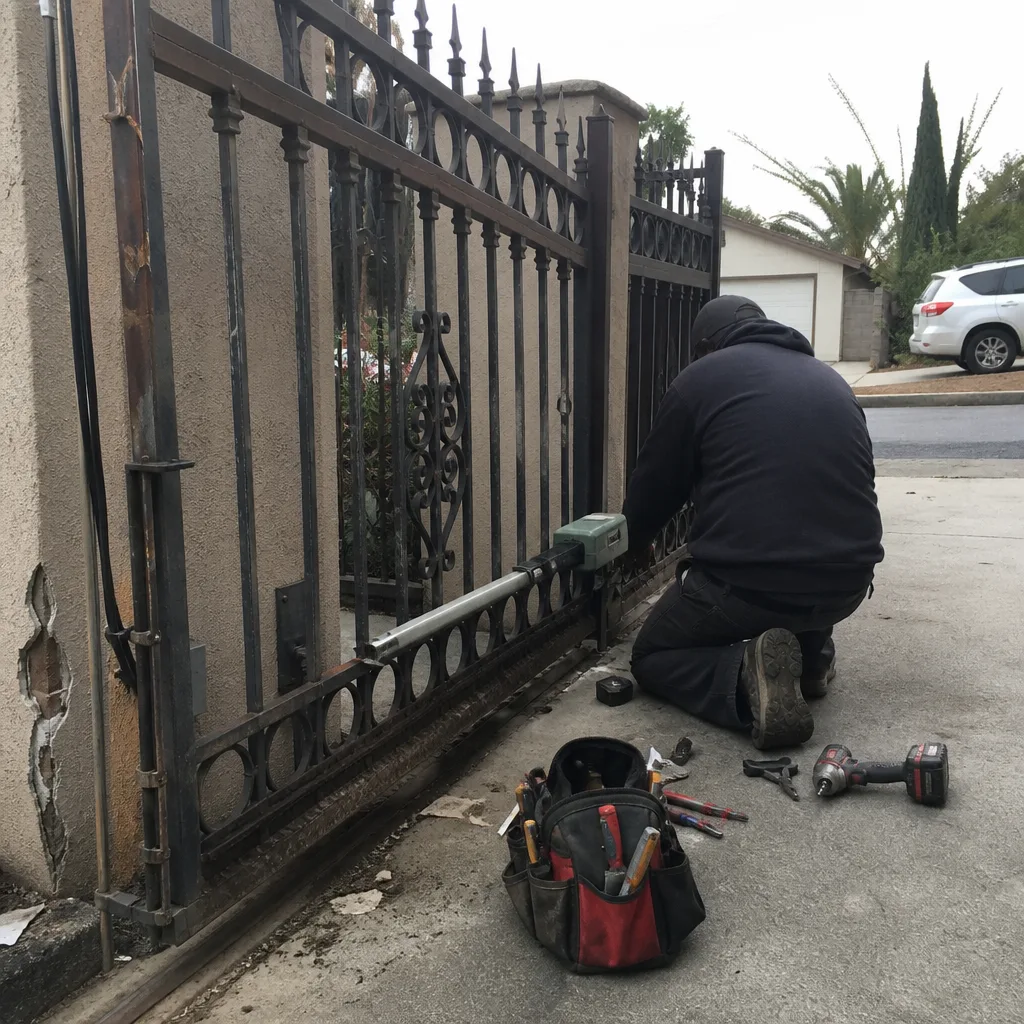 Before
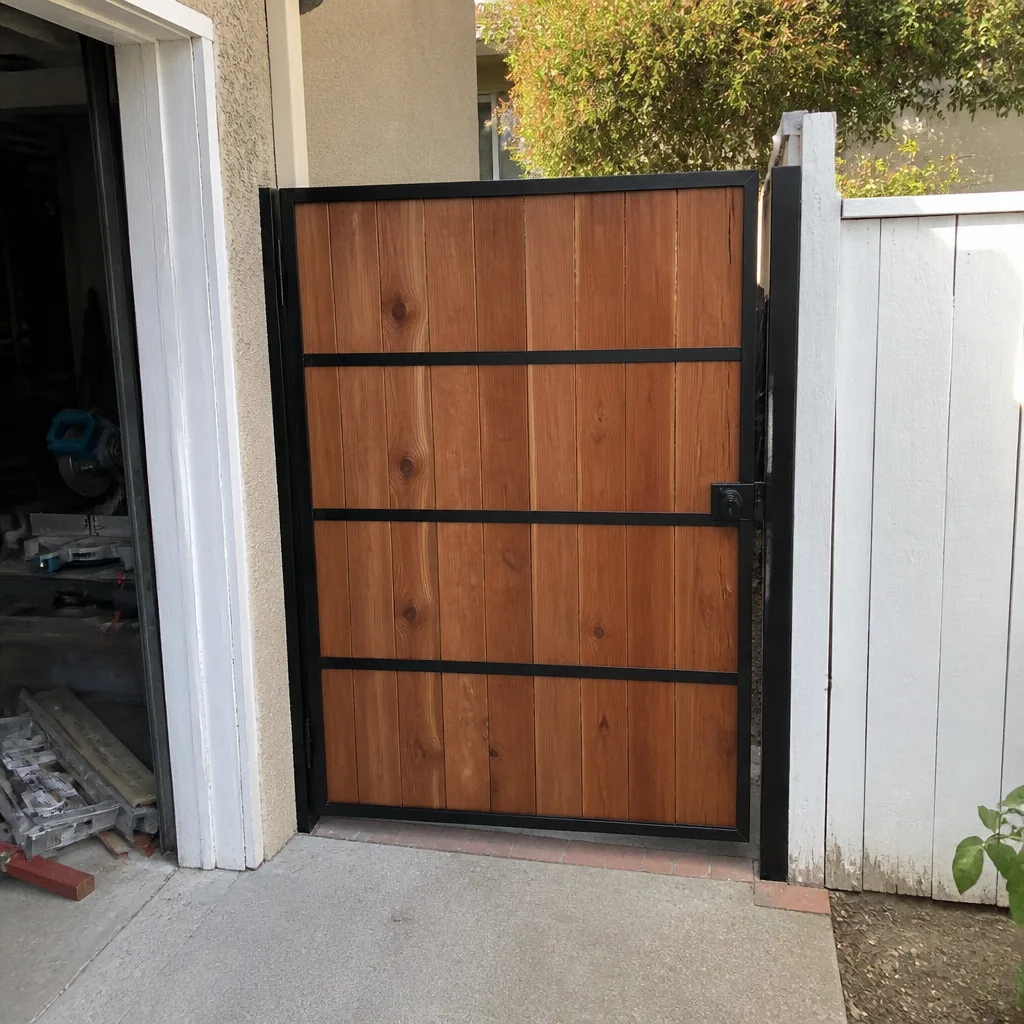 After
AfterGate Repair Maintenance Checklist for Alhambra Homeowners
Most Alhambra homeowners don’t think about their driveway gate until it stops moving. Then it’s 7:15 on a Tuesday morning, the car is trapped in the driveway, and the whole day unravels. Here’s the part nobody tells you: the gate that failed this morning probably started failing eight months ago, quietly enough that nobody noticed. A bolt loosening a quarter-turn. A hinge collecting grit from the San Gabriel Valley winds. A capacitor aging in the motor housing. The repair bill that finally forces the call is almost always the last chapter of a slow deterioration, not a sudden lightning strike. This guide is a maintenance checklist written for Alhambra homeowners who would rather spend fifteen minutes a month than a thousand dollars at the worst possible moment. By the end, you’ll know exactly what to check, what to ignore, what to fix yourself, and when to pick up the phone.
Quick Answer
A practical gate repair maintenance checklist for Alhambra homeowners comes down to this: inspect hinges and welds monthly for rust and movement, clean the track every 60 to 90 days, test the safety reversing mechanism twice a year, keep the motor housing dry and clear of debris, and address small problems the week they appear rather than waiting until the gate stops. Most gate failures are preventable with about fifteen minutes of attention each month.
Table of Contents
- How Alhambra’s Climate Wears Down Your Gate
- The Monthly Visual Inspection: 10 Minutes That Saves Real Money
- Hinges, Welds, and the Metal Itself: The Blacksmith’s Checklist
- Track and Rollers: Cleaning What Keeps the Gate Moving
- Gate Motors and Openers: What to Check Without Taking Anything Apart
- Safety Sensors and Auto-Reverse: The Non-Negotiable Test
- Seasonal Checklist for Alhambra: Spring Winds and Summer Heat
- Electrical and Access Control: Keypads, Photocells, and Power
- Common Mistakes to Avoid
- When to Call a Professional
- Frequently Asked Questions
- The Bottom Line
How Alhambra’s Climate Wears Down Your Gate
Alhambra sits in the western San Gabriel Valley, which means your gate deals with three specific conditions that a gate in Pasadena or Monterey Park handles a little differently. First, we get real wind through the mountain passes, and that wind carries fine grit that works its way into rollers, hinge pins, and motor brushes. Second, the heat builds in the afternoon and cools fast at night, which expands and contracts every steel component on your gate. Third, even though Alhambra is dry compared to the coast, we still get enough morning dampness and the occasional heavy rain to start surface rust on unprotected welds. In our experience, gates in the North Alhambra neighborhoods near the Alhambra Golf Course tend to collect more leaf debris in the track, while gates south of Main Street see more wind-driven dust. Neither condition is fatal on its own. What matters is that you check for both.
A well-built steel gate in Alhambra should give you 20 to 30 years of service if the moving parts are maintained. An unmaintained gate with the same build quality might need major repair in seven. The metal doesn’t fail first. The moving parts do, and they take the metal with them when they go.
The Monthly Visual Inspection: 10 Minutes That Saves Real Money
Once a month, stand in front of your closed gate and look at it the way a tradesman would. Not as a homeowner admiring the curb appeal, but as someone looking for the first sign of trouble. This monthly pass catches problems while they are still cheap to fix.
Here is the ten-minute monthly routine, in order:
- Watch the gate open and close fully, one complete cycle. Listen for new sounds: a scrape, a groan, a pause mid-travel. A healthy gate moves smoothly and sounds consistent all the way through. Any new noise is a mechanical component telling you something.
- Look at the gate from 10 feet back while it’s closed. It should sit level. If one corner sits higher than the other, the hinges are wearing or the post is shifting.
- Check the welds at each hinge connection. Look for hairline cracks in the paint or powder coat around the weld. Cracks in the coating are the first visible sign of metal fatigue.
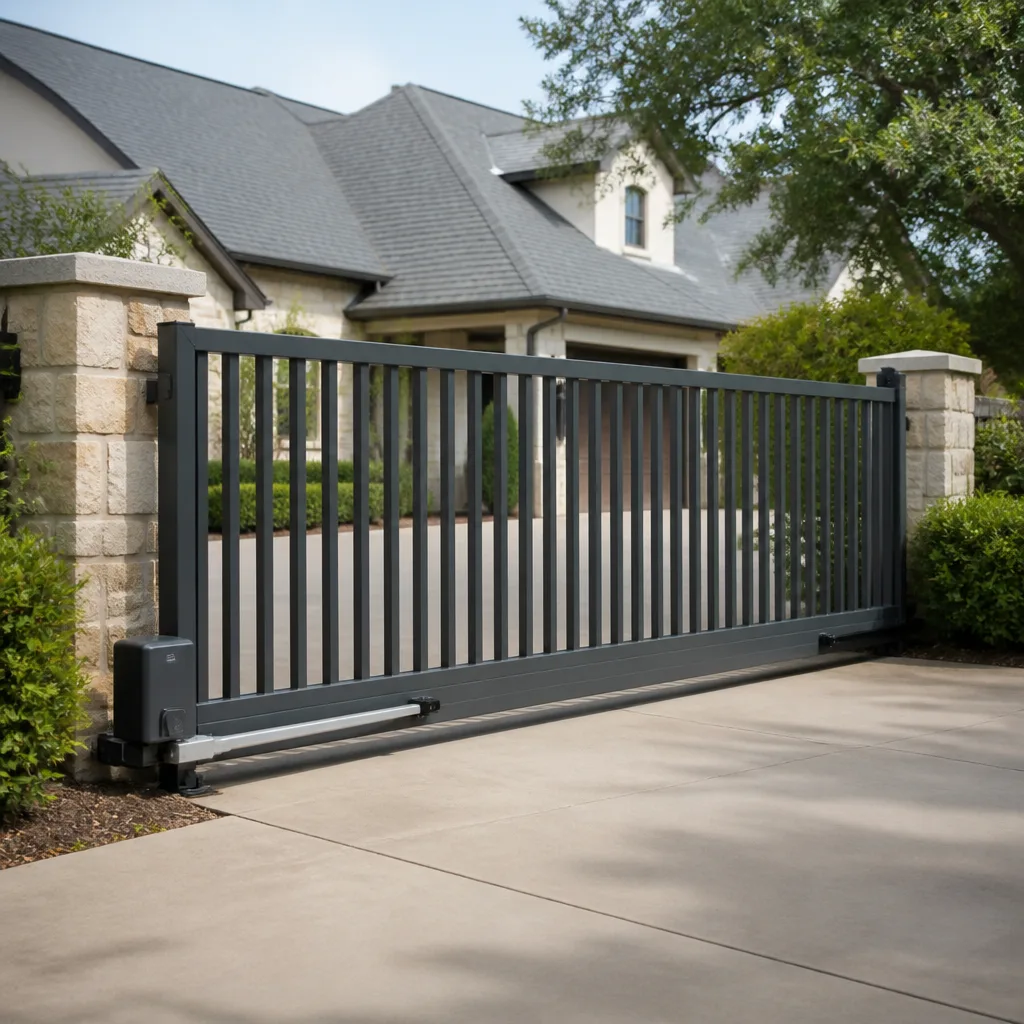
- Examine the ground track if you have a sliding gate. Clear out leaves, gravel, and anything that has blown in from the street. A pebble the size of a marble is enough to bind a roller.
- Test the manual release, if you know how. Most Alhambra driveway gates built in the last twenty years have a manual override. Operating it once a month keeps the release mechanism from seizing up, and it confirms you can still get your car out during a power outage.
- Check the gate sensor or photocell eyes near the ground. A quick wipe of the lenses with a dry cloth keeps them reading correctly. Dirt on a photocell is one of the most common causes of a gate that reverses for no apparent reason.
This routine takes ten to fifteen minutes. It is the single most cost-effective thing an Alhambra homeowner can do for a driveway gate, and it works equally well whether your gate is a rolling gate on tracks, a swing gate on hinges, or a vertical lift gate at the end of a long driveway.
Hinges, Welds, and the Metal Itself: The Blacksmith’s Checklist
The metal is the soul of the gate. Everything else, the motor, the keypad, the sensors, is bolted onto it. When the metal fails, every other component fails with it. Victor Salinas started Ironworks Gate Co. as a welding shop, and the first thing he teaches every technician is to read the metal before touching the electronics. Here is what a homeowner should look for.
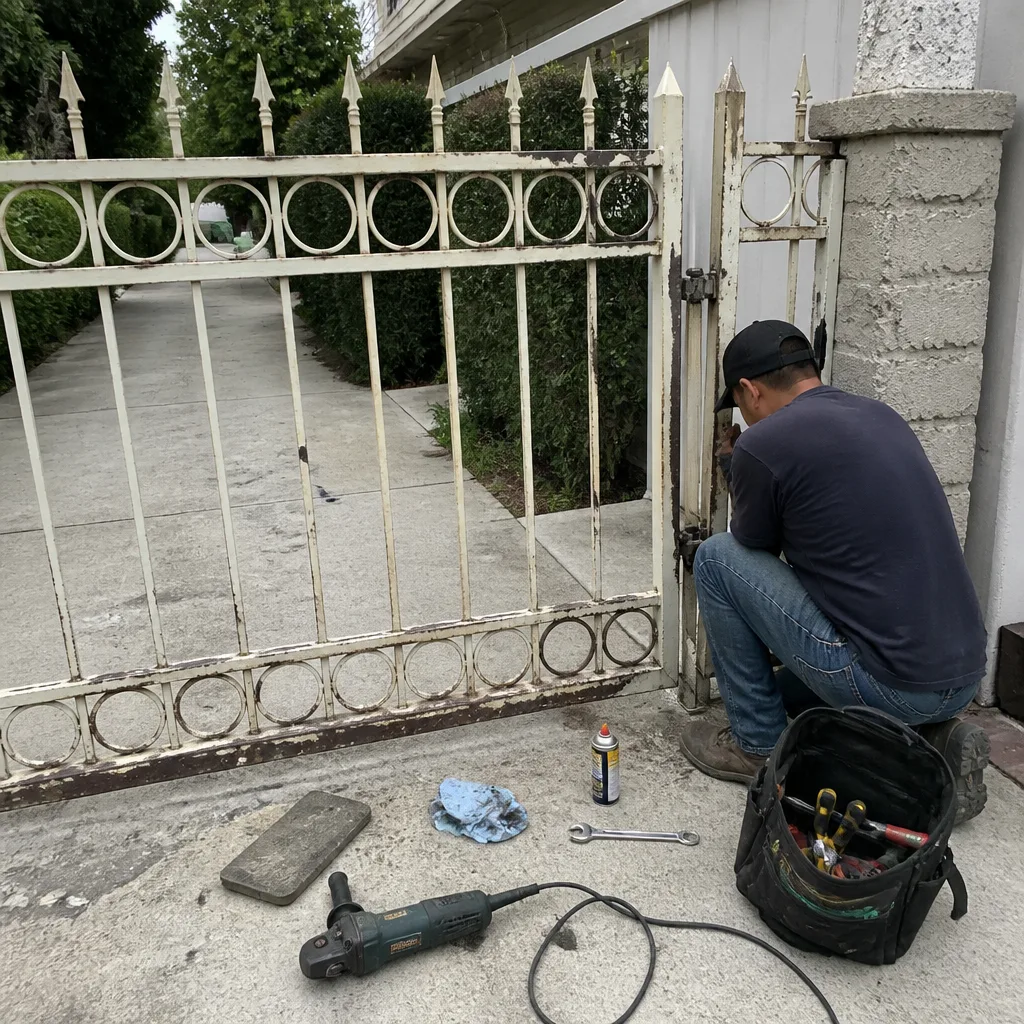
Rust and corrosion. Surface rust is cosmetic. Deep rust is structural. The difference is whether the metal still rings when you tap it or sounds dull and dead. In Alhambra, most rust starts at the bottom corners of the gate, where water pools after rain, and at the weld points where the original protective coating was burned off during fabrication. If you catch rust while it is still surface level, you can wire-brush it, hit it with a rust converter, and repaint. If it has pitted the metal, the repair is a welding job, not a paint job.
Hinge wear. A swing gate hangs on two or three hinges, and each hinge is a bearing surface. As the bushings inside the hinge wear, the gate starts to sag. You’ll see it first as a gap at the top corner opposite the hinges that is narrower than the gap at the bottom corner. A sagging gate puts tremendous stress on the motor, because the motor is now fighting gravity in addition to moving the gate’s weight. In Alhambra, we see hinge wear accelerate on gates that face west, because the afternoon sun bakes the grease out of the hinge pins.
Weld cracks. Examine every weld you can see on the gate frame. A crack in the weld is not a cosmetic issue and it will not heal itself. It will propagate, and eventually the weld will separate. A cracked weld on a 400 pound swing gate is a serious safety matter. This is the point where you call a blacksmith, not a handyman.
Post movement. The gate is only as stable as the posts holding it. Walk to each post and push on the gate. There should be zero movement at the post. If the post flexes, the concrete footing is failing or the post was undersized from the start. This is a significant repair, but catching it early, before the post leans, is the difference between a $500 reinforcement and a $4,000 re-set.
Track and Rollers: Cleaning What Keeps the Gate Moving
For sliding gates, the track is a maintenance item people forget about until the gate starts jumping. Alhambra’s dry wind deposits more grit in a track in one summer than a coastal track sees in a year. That grit grinds against the rollers with every single cycle, and eventually the rollers develop flat spots. A gate with flat-spotted rollers sounds like a shopping cart with a bad wheel.
Here is a track and roller maintenance routine, best done every 60 to 90 days:
- Clear the full length of the track. Use a stiff brush or a gloved hand. Remove leaves, gravel, dog hair, and the fine gray dust that builds up around the wheels.
- Inspect the rollers with a flashlight. Look for flat spots, wobble, or visible wear on the wheel surface. A roller with a flat spot needs replacement. Running a track on bad rollers wears the track itself, and a new track is a much bigger job than a new set of rollers.
- Check the track for bends or dents. A sliding gate weighs hundreds of pounds. If a delivery truck or a neighbor’s car has ever clipped the track, even slightly, it may have a bend you can’t see from a standing height. Get down and look along the length of the rail. Any deviation in a straight line is trouble.
- Lubricate the rollers, not the track. A thin film of a dry silicone spray or white lithium grease goes on the roller bearings and wheel axles. Do not grease the track itself. Grease on the track collects dust and grit, creates a grinding paste, and accelerates wear. In Alhambra’s dry winds, a greasy track is a dirt magnet.
- Verify the gate sits square on the track. If one side of the gate rides higher, a guide wheel is out of adjustment or the track itself has shifted. This puts uneven load on the motor and shortens its life.
If you have a swing gate, skip the track work and spend that time on hinge lubrication. The same principle applies: lubricate the moving metal parts, and do not leave excess grease exposed to Alhambra dust.
Gate Motors and Openers: What to Check Without Taking Anything Apart
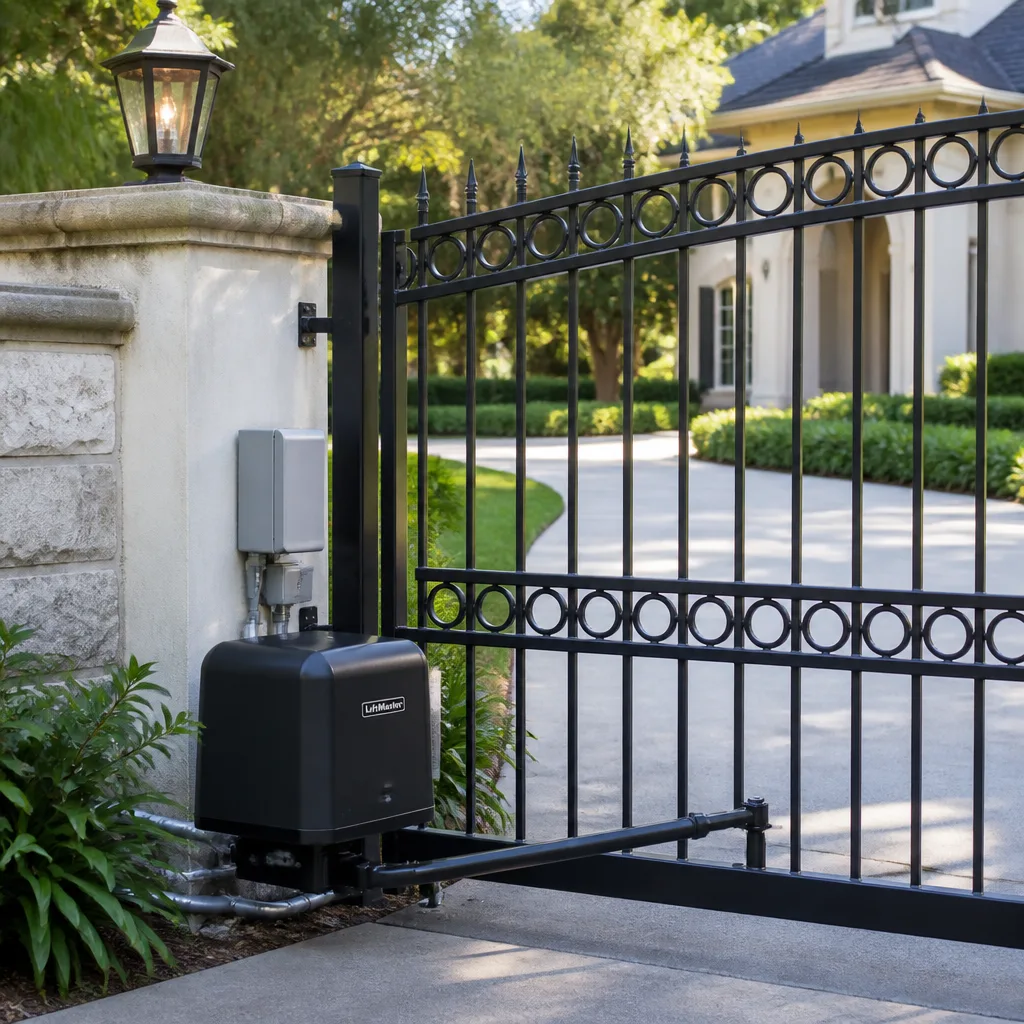
The motor is the most expensive repair on any automated gate, and the most preventable. We service nine major opener brands at Ironworks Gate Co., including Linear, Viking, and DoorKing, and across all of them, the failure patterns are the same. Motors die from heat, moisture, and overwork. The maintenance checklist below addresses all three, and it requires no tools and no electrical knowledge.
Heat. In Alhambra, summer afternoons push 100 degrees, and a motor housing in direct sunlight gets hotter than that. The thermal protection inside the motor will shut the unit down before it destroys itself, but repeated thermal cycling shortens the life of the capacitors and the motor windings. Check that the motor housing has airflow around it. If the previous owner planted bougainvillea or a hedge around the motor box, trim it back. A shady or ventilated motor runs cooler and lasts years longer.
Moisture. Even in dry Alhambra, sprinklers are a gate motor’s quiet enemy. Walk out and look at the motor housing. If a lawn sprinkler has been spraying the housing every morning for the last two years, you have a moisture problem. Water finds its way into the housing through the conduit fittings, and it corrodes terminals and circuit boards from the inside. Aim the sprinkler away from the motor. If the housing has condensation inside it after a rain, leave the cover off for a day to dry it out, then track down where the water is entering.
Overwork. Listen to the motor when the gate operates. A motor that strains, hums, or labors is working against mechanical resistance. The usual culprit is a dry hinge, a dirty track, or a gate that has sagged out of alignment. Fixing the mechanical issue takes the load off the motor and saves you from buying a new opener for a problem that was never electrical.
Every three months, do one more thing: operate the gate from the wall button, the keypad, and each remote you own. A Ghost Controls opener that works from the keypad but not the remote is telling you something about the receiver board or the remote programming, not the motor itself. You want to catch that kind of issue before the only control left is the one that stops working on a Sunday night.
Safety Sensors and Auto-Reverse: The Non-Negotiable Test
Every automated gate sold in the United States is required to have an auto-reverse safety mechanism. If the gate meets resistance while closing, it must stop and reverse. This system exists because driveway gates have killed people. They have killed children. This is not a suggestion or a best practice. It is the single most important safety system on your property.
Test it twice a year. Here is the procedure:
- Place a solid object in the gate’s path. A filled five-gallon bucket works well. It needs enough mass that the gate will hit real resistance, but not so much that it damages the gate if the auto-reverse fails.
- Close the gate.
- Watch what happens. The gate should stop and reverse within a second of hitting the bucket. If it keeps pushing, stalls, or reverses only after a long delay, the sensitivity setting is wrong or the safety system has failed.
- Repeat the test with the object at knee height and at chest height. Some systems have dead zones where the sensor doesn’t register resistance properly.
If the gate fails this test, disable the motor and call a professional. The gate may still have a secondary reversing edge or photocell system, but a failed primary resistance sensor is a sign that the safety electronics are compromised. This is never a repair to postpone. Viking and DoorKing openers have different sensitivity adjustment procedures, and getting the setting wrong in either direction is dangerous, too sensitive and the gate reverses on a stiff breeze, not sensitive enough and it will not stop for a child. This is one area where a homeowner should not guess.
The photocell sensors at the base of the gate also need attention. These are the small units, usually about knee height, that project an invisible beam across the gate opening. Wipe the lenses with a dry cloth monthly. If the gate closes only partially and then reopens for no reason, dirty photocells are the most common cause, and the fix takes thirty seconds.
Seasonal Checklist for Alhambra: Spring Winds and Summer Heat
Alhambra has two seasons that matter for gate maintenance: the windy season and the hot season. Here is what to do as each one arrives.
Before the spring winds arrive (March and April):
- Clear the track of all winter debris and check for anything that has sprouted near the gate line. Grasses and weeds that grow up through the track will bind the rollers.
- Tighten every visible bolt and fastener. Wind vibration loosens hardware over time, and a gate that chatters in a 30 mile per hour gust is taking cumulative damage.
- Check the gate’s end stops. These are the mechanical limits that stop the gate at fully open and fully closed. If they have drifted, the gate slams at the end of each cycle, and that shock travels straight through the frame to the motor.
- Inspect the gate itself for anything that could become airborne in high wind. Loose decorative elements, address plates, and gate-mounted lights should be secure.
Before the summer heat peaks (June and July):
- Verify the motor housing has adequate shade. A shade cloth or a trimmed-back hedge can drop the internal motor temperature by 15 to 20 degrees during an Alhambra afternoon.
- Test the auto-reverse. Heat causes metal to expand, and expansion can change the gate’s closing resistance. The setting that was safe in April may need adjustment in August.
- Check that the gate’s battery backup, if you have one, is holding a charge. Heat kills lead-acid batteries faster than anything else. A backup battery that has cooked through a summer in direct sun may not work when the power goes out.
- Listen for a change in motor pitch on hot afternoons. A motor that works fine in the morning but strains at 3 PM is telling you that thermal protection is engaging. This is the time to check for mechanical drag before the motor fails permanently.
Electrical and Access Control: Keypads, Photocells, and Power
The access control side of an automated gate is the part that seems mysterious to most homeowners. It is also the part where small problems turn into big service calls, because the failure is invisible until the keypad stops accepting your code or the gate opens for the mail carrier and then refuses to close.
Keypads. If you have a keypad on a pedestal outside the gate, check it monthly for cracks in the faceplate or the housing. A cracked keypad lets water into the circuit board. In Alhambra, we see more keypad failures from sprinkler overspray than from rain. If the buttons feel sticky or require a hard press, the membrane is failing. Replacement is simple and inexpensive compared to the service call when the keypad dies completely.
Photocells. These were covered in the safety section, but they belong on the electrical checklist too. A photocell that is misaligned or obstructed will stop the gate from closing. The usual symptom is a gate that opens fine but refuses to close unless you hold the override button. If that happens, check the photocells before calling for service. One lens dirty is usually the whole story.
Power supply. Your gate opener runs on the electrical circuit from the house. When that circuit trips, the gate stops working and the battery backup, if present, takes over. If your gate works on battery power but the main circuit is dead, do not keep running it on battery indefinitely. The charger circuit may be fine, but whatever tripped the breaker needs to be found and fixed. A continuously tripping gate circuit means a ground fault somewhere, and ground faults in outdoor wiring are the kind of problem that gets worse with moisture and time.
Battery backup. If your system has backup batteries, mark your calendar to check them every spring and fall. Most backup batteries last three to five years in Alhambra’s climate, less if the battery box is in full sun. A dead backup battery means your gate fails completely the next time the power goes out, and on the wrong morning, that means a car trapped in the driveway.
When any of these electrical issues shows up, record the symptom before you call. What works, what doesn’t, the weather conditions, and the time of day. The person who answers the phone at Ironworks Gate Co. can often diagnose a keypad or photocell issue over the phone, and a clear symptom history makes that possible.
Common Mistakes to Avoid
- Waiting until the gate stops to call. Every gate gives warning signs for weeks or months before it fails. A new noise, a slight hesitation, a gate that reverses for no reason. These are the cheap repairs. The full failure is always more expensive.
- Lubricating the track with WD-40. WD-40 is a solvent, not a lubricant. It displaces the grease that is already there and leaves the metal dry. Dry track metal and dry roller bearings wear fast. Use a dry silicone spray or white lithium grease on the moving parts only.
- Ignoring a sagging gate. A swing gate that sags even an inch is putting hundreds of pounds of extra strain on the motor every time it cycles. The motor will eventually burn out, and the repair bill will include both a motor replacement and the hinge repair that cost much less six months earlier.
- Painting over rust. Paint does not stop rust. It hides rust while the oxidation continues underneath, and when the paint finally bubbles, the structural damage is worse than it was. Clean the rust down to bare metal, treat it, then paint.
- Disconnecting the safety sensors because they are annoying. A gate that reverses when it should not is frustrating. Bypassing the sensor is dangerous and is a code violation. Fix the sensor, don’t defeat it.
- Assuming the warranty covers neglect. Every gate opener brand has warranty language excluding damage from lack of maintenance. A motor that fails because the gate was never lubricated is not a warranty claim. A maintenance log, even a simple one in a notebook, is your proof if you ever need it.
When to Call a Professional
Some gate problems are homeowner maintenance. Some are professional repairs. Knowing the difference saves money in both directions. You can clean a track, wipe a photocell, adjust a sensor, and tighten a bolt. You should not attempt to replace a spring under tension, weld a cracked hinge, re-set a leaning post, or rewire an opener circuit. These are jobs where a mistake means serious injury or a gate that fails catastrophically. A sliding gate weighs hundreds of pounds. A spring-loaded swing gate has stored energy. Electricity and metal and water are a dangerous combination. If a repair involves any of those three, call someone who does this work for a living. Ironworks Gate Co. offers free estimates in Alhambra. Call (747) 277-8422 and describe what the gate is doing. A live person answers, 24 hours a day, every day. The price is quoted before any work starts, and every job carries the 90-Day Done Right Promise in writing.
Frequently Asked Questions
Do the monthly visual inspection every 30 days, the track and roller cleaning every 60 to 90 days, and the full safety and seasonal checks twice a year. That adds up to roughly three hours of total maintenance per year. Most gate failures in Alhambra happen on gates that have had no maintenance at all in the previous twelve months. For a professional once-over, call (747) 277-8422 and ask about the $89 seasonal tune-up.
The first sign is almost always a new noise. A scrape, a groan, a click, a hum that wasn’t there before. The second sign is a change in movement: the gate slows down, hesitates, or stops and reverses mid-cycle. The third sign is visible wear: rust at the hinges, a sag in the gate, a bent track. Any one of these is a reason to investigate now, not after the gate stops.
Cleaning, lubricating, and visually inspecting are homeowner jobs. Adjusting motor sensitivity, replacing torsion springs, welding cracks, and troubleshooting electrical faults are not. The line is simple: if the repair involves a spring under tension, a motor’s internal wiring, or a structural weld, call a professional. In Alhambra, Ironworks Gate Co. handles all of it, and the estimate is free.
Most gate repairs in Alhambra fall between $150 and $600. A new keypad or photocell is on the lower end. A motor replacement for a Linear or Viking opener runs higher, depending on the model and the amount of labor. A structural repair like a re-set post or a welded frame section can exceed that range. Every job starts with a written quote before any work begins. Call (747) 277-8422 and we will walk you through it, and remember that any repair over $250 qualifies for $50 off.
Ninety percent of the time, a gate that opens but won’t close has a photocell issue. The photocells at the base of the gate are either dirty, misaligned, or obstructed. Wipe both lenses with a dry cloth and check that nothing is blocking the beam path. If the gate still refuses to close, the sensor may be failing, and that is a quick diagnostic call to (747) 277-8422.
DoorKing and Ghost Controls openers are sophisticated pieces of electronics, and both brands have specific service procedures. Homeowner maintenance like cleaning and visual checks is the same as any other brand. But when it comes to board replacement, sensitivity settings, or programming, a trained technician is the right call. Ironworks Gate Co. works on these brands every week in Alhambra and can service whatever is on your driveway.
The Bottom Line
A driveway gate is a machine, and like any machine, it rewards routine attention and punishes neglect. Alhambra’s wind, heat, and dust make that true here more than most places. The monthly inspection catches the $25 problem before it becomes the $800 failure. The track cleaning keeps the rollers round and the motor cool. The safety tests keep your family safe and keep the gate compliant with the law. If all of that sounds like fifteen minutes a month you don’t have, that’s fine too. Call (747) 277-8422 and let someone else do it. The estimate is free, the price is settled before the work starts, and the repair is backed by a written 90-Day Done Right Promise from a company that has been in Alhambra since 2013 and plans to be here another forty years. A square deal, every time, in writing.
Written by Victor Salinas, Owner at Ironworks Gate Co., serving Alhambra since 2013.