
Last updated August 25, 2026
Free on-site gate assessment - hinges, posts, and your LiftMaster or Nice gate operator checked before anything is quoted
The assessment is free and the quote is the invoice.
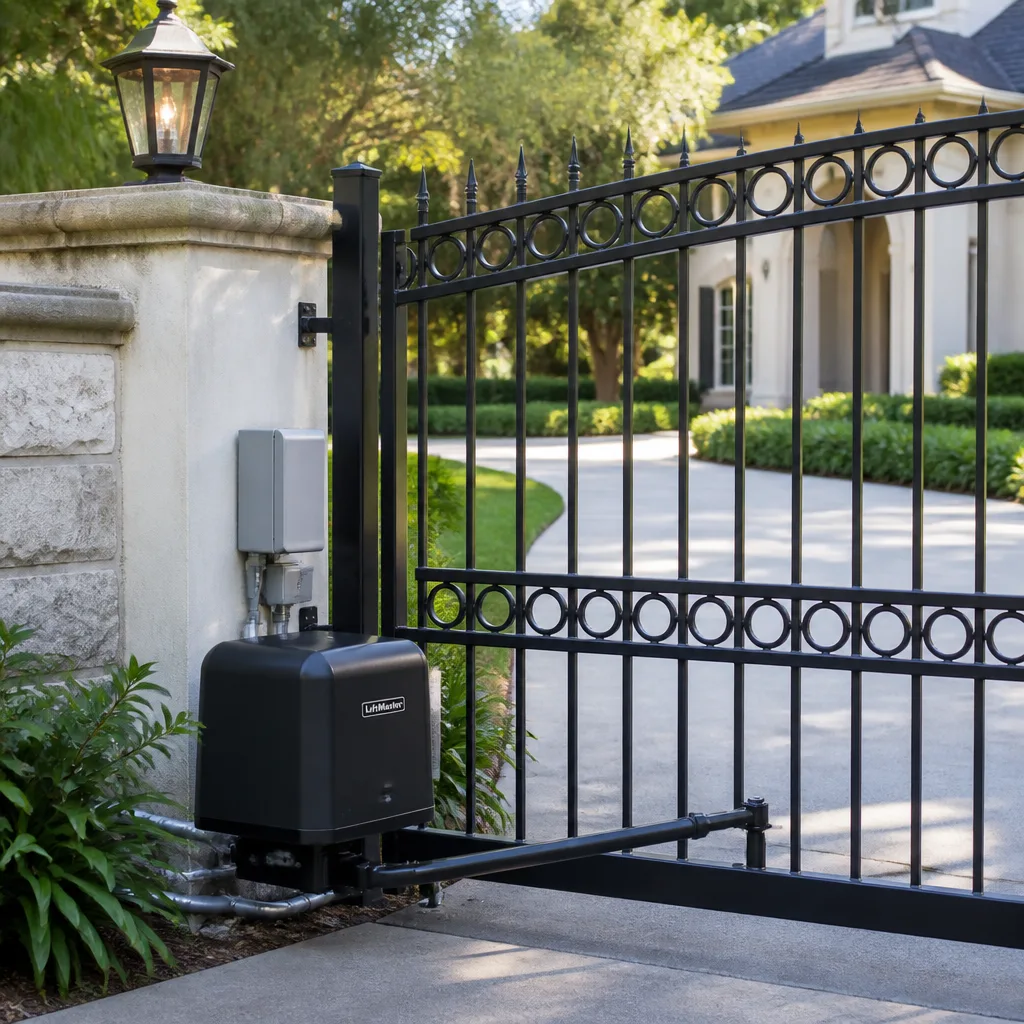
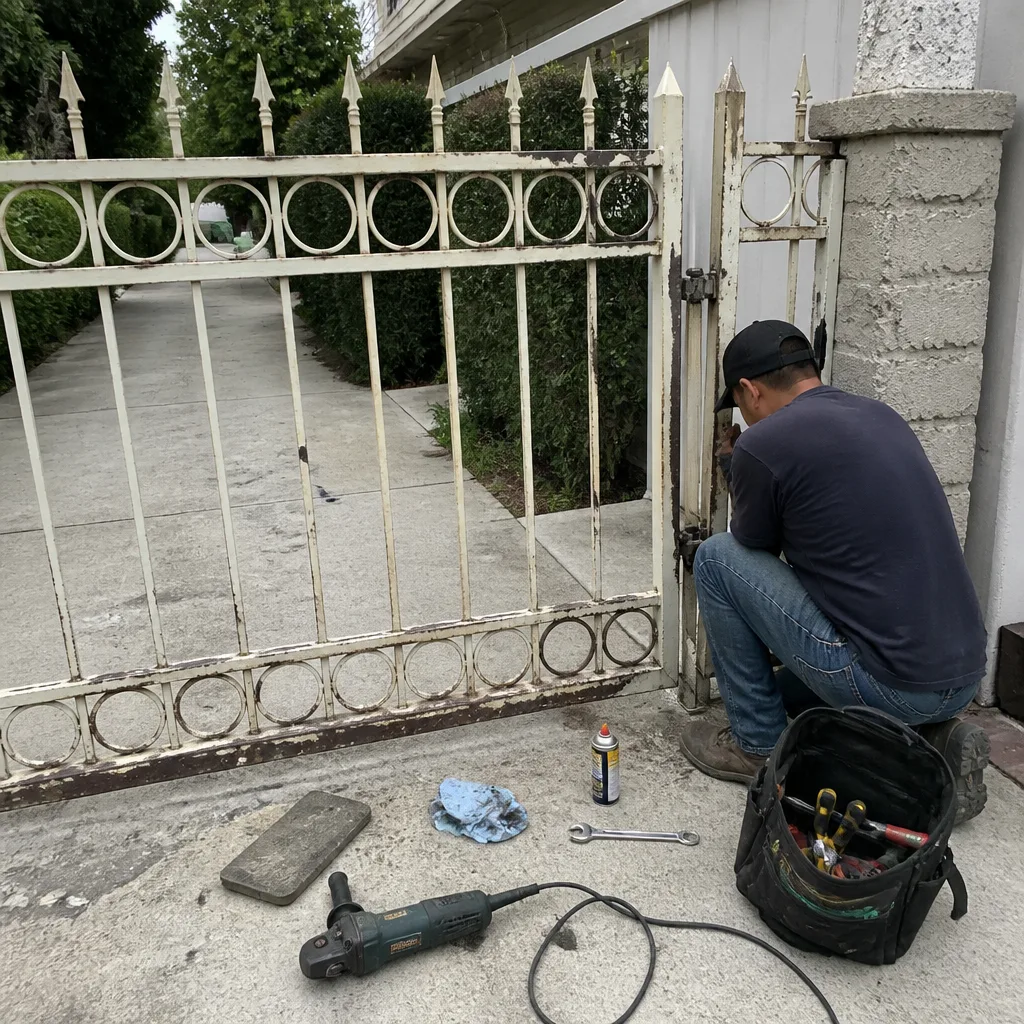 Before
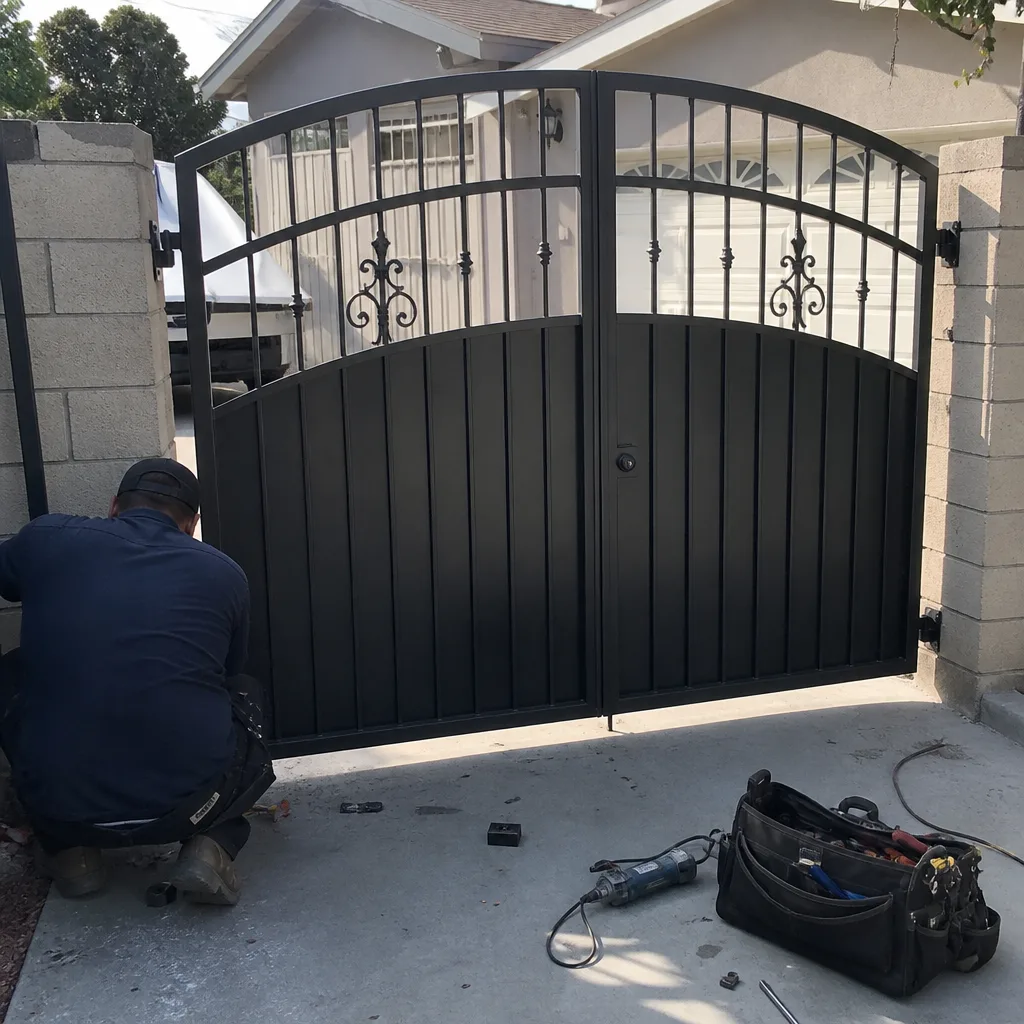 After
After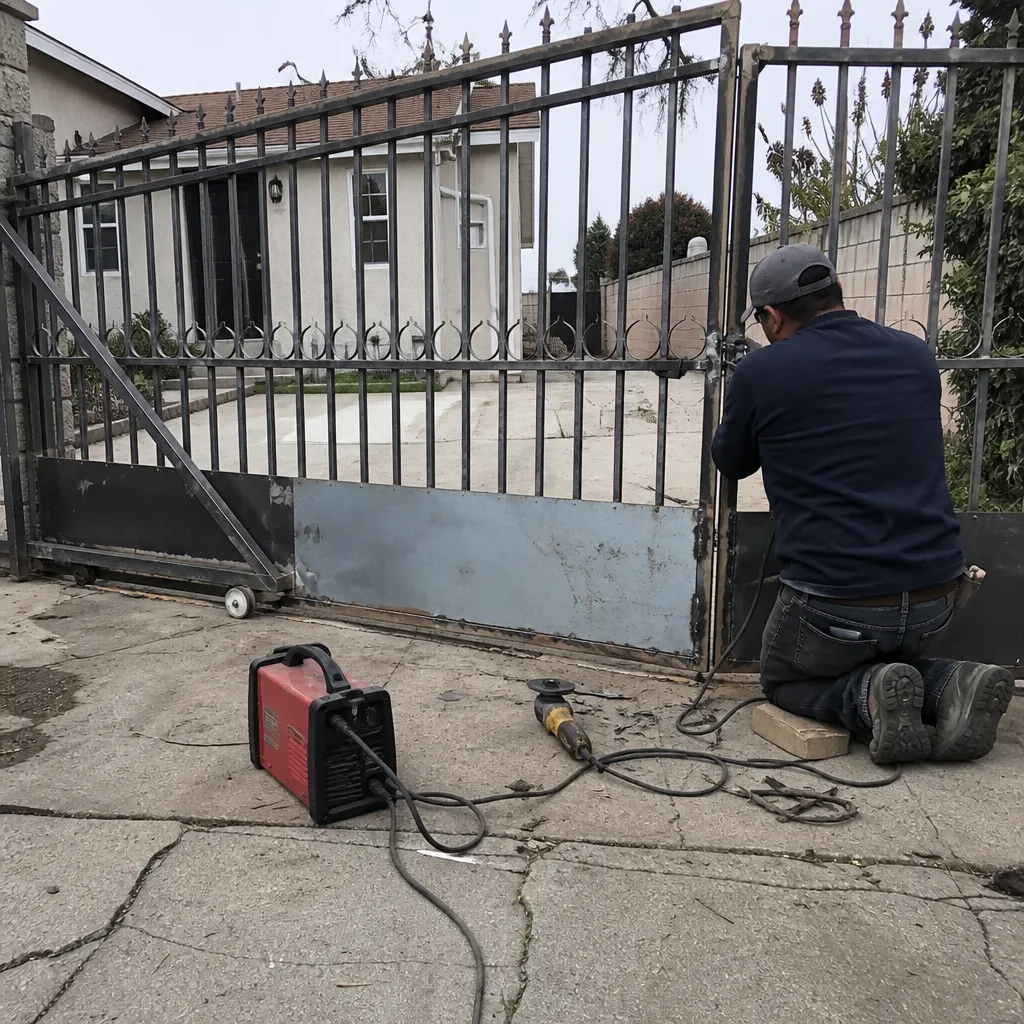 Before
 After
After Before
 After
AfterGate Repair Warning Signs: A Alhambra Homeowner’s Reference Guide
Most Alhambra gates don’t fail all at once. They send signals for weeks or months beforehand, and homeowners who learn to read those signals avoid the 2 a.m. failure, the car trapped in the driveway, and the repair bill that’s three times what it would have been if caught early. This guide covers the warning signs we’ve learned to recognize over decades of working on gates in Alhambra, from subtle hinge groans to the way a motor sounds right before it gives up. You’ll learn what each sign means, what it costs to fix in this market, and when a repair can wait versus when it can’t.
Quick Answer
The most common gate repair warning signs in Alhambra are grinding or scraping sounds during operation, a gate that moves slower than it used to, sagging or visible leaning, rust at the hinge points, and an opener motor that hums but doesn’t move the gate. Any of these, left alone for more than a few weeks, typically turns a $150 hinge repair into a $900 weld-and-realign job. If your gate is making a new sound or moving differently than it did last month, call a gate specialist for an inspection before the failure becomes a replacement.
Table of Contents
- Sound Warnings: The Noises That Predict Failure
- Movement Warnings: Speed, Jerking, and Drift
- Structural Warnings: Sag, Rust, and Loose Hardware
- Opener and Motor Warnings: What the Machine Is Telling You
- Electric and Safety Warnings: Photocells, Keypads, and Fault Codes
- Alhambra-Specific Gate Problems: Climate, Soil, and Code
- What You Can Check Yourself (And What You Shouldn’t Touch)
- What Gate Repairs Actually Cost in Alhambra
Sound Warnings: The Noises That Predict Failure
Gates talk. A properly hung, properly maintained gate in Alhambra makes almost no sound at all when it opens and closes: a low, even motor hum if it’s automated, and nothing else. When a new sound appears, the gate is telling you something specific. In our experience, homeowners who call us the week a sound starts get a repair. Homeowners who wait three months get a replacement.
Grinding or Scraping
A grinding sound almost always means metal on metal where there shouldn’t be. The most common cause in Alhambra is a bearing that’s worn through its grease and started eating itself, usually on the bottom hinge where it takes the full weight of the gate leaf. Scraping, by contrast, is usually the gate itself dragging against the driveway, the post, or the latch plate. Concrete pads shift in Alhambra’s clay soil, especially after wet winters, and a gate that cleared the ground by two inches in 1998 may be dragging today. Grinding means replace the bearing. Scraping means adjust the hinges or re-level the post. Both are far cheaper when caught within the first few weeks.
Squealing or High-Pitched Whine
A squeal from the hinge area is typically a dry hinge pin crying for lubrication, and on many Alhambra gates built in the 1980s and 1990s, the hinge has a grease fitting that hasn’t been touched since the Clinton administration. A squeal from the motor housing is different and more serious: it usually indicates a belt or gear inside the opener that’s losing tension or lubrication. Motor squeals don’t fix themselves. They get louder until the opener seizes.
Clunking or Thumping
A rhythmic clunk as the gate moves is usually the chain or rack-and-pinion drive hitting a worn tooth or a stretched chain link. On sliding gates, which are common on Alhambra’s hillside properties, the track rollers wear flat spots over time and produce exactly this sound. On swing gates, a clunk often comes from a loose hinge bolt that allows the gate to shift a fraction of an inch with every cycle. Tighten it and the sound disappears. Ignore it and the bolt hole elongates, which becomes a welding job.
Key takeaway: any new sound from your gate has a specific, diagnosable cause. The sound itself tells a trained ear what’s failing. The longer it goes on, the more secondary damage it creates.
Movement Warnings: Speed, Jerking, and Drift
Changes in how the gate moves are the second major category of warning signs, and in some ways they’re more telling than sounds because they reflect the whole system: the hinges, the motor, the drive, and the control board all working together. A healthy Alhambra gate opens and closes at a consistent speed, every time, regardless of the temperature or how recently it rained.
Slower Than It Used to Be
If your automated gate now takes noticeably longer to open than it did six months ago, something is adding resistance to the system. The usual suspects in Alhambra are: hinge bearings losing their grease and adding friction, a gate that’s begun dragging on the driveway because the post has settled, or a motor whose capacitor is weakening. The capacitor is the most interesting of the three because it fails gradually. It’s a $40 part. If it fails completely, the motor hums and doesn’t turn, which homeowners often misdiagnose as a dead motor and get quoted $800 to replace. We see this exact scenario multiple times a year in Alhambra.
Jerking or Hesitating Mid-Travel
A gate that moves smoothly for three feet, then jerks, then moves smoothly again has a drive problem. On chain-drive sliders, it’s usually a stretched chain or a worn sprocket. On rack-drive gates, it’s often a missing or damaged tooth on the rack. On swing gates with articulated arms, it’s frequently a worn joint in the arm itself. None of these are catastrophic. All of them get worse with every cycle. A jerking gate is a gate asking for maintenance.
Drifting or Swaying
A swing gate that drifts open on its own, or settles slightly lower than it should, has a hinge problem or a post problem. In Alhambra, where many homes sit on the alluvial soil that shifts between the dry season and the rainy season, posts can settle unevenly. A gate that dragged nothing in August may catch the driveway by March. If the gate drifts, the hinge alignment is off. If the post has settled, the fix is more involved: the post needs to be re-set or the hinges re-engineered to account for the new angle. We’ve done both, many times, on Alhambra’s older hillside lots.
Structural Warnings: Sag, Rust, and Loose Hardware
Structure is where Alhambra’s climate does its quiet, patient work. The same sunny, dry weather that makes this city pleasant to live in also dries out paint, opens micro-cracks in coatings, and lets moisture into metal. Add the marine layer that rolls in on summer mornings and you have the perfect conditions for slow, steady corrosion.
Visible Sag
Stand at the curb and look at your gate. The top rail should be level. If it isn’t, the gate is sagging. Sag almost always starts at the hinges, where the fasteners are carrying the entire cantilevered weight of the leaf. A mild sag is a hinge adjustment. A severe sag, where the gate has pulled the screws out of the post or torn the post out of plumb, is a structural repair that may require welding or post replacement. The price difference between the two is roughly ten times, and the only thing that determines which one you get is how long the sag was allowed to continue.
Rust at the Hinges and Weld Points
Not all rust is urgent. Surface rust on a wrought-iron Alhambra gate is normal after thirty years and can be brushed, treated, and repainted. But rust at a hinge point or a weld joint is different: that’s where moisture sits, where the metal is under stress, and where the rust is eating into the structure rather than sitting on top of it. Look for rust that flakes off in layers, or rust that has reduced the thickness of the metal. If you can see the rust swelling the joint apart, that joint is compromised. Weld repairs on Alhambra gates run from a few hundred dollars to a few thousand depending on the gate’s size and style, but they’re always cheaper than the day the joint gives way and the gate falls off its post.
Loose Hardware: Bolts, Screws, and Pins
Hardware loosens. It’s the nature of a machine that cycles hundreds of times a month, day after day, year after year. The warning sign isn’t a loose bolt; it’s a loose bolt that stays loose. When a hinge bolt works its way out and you tighten it once and it stays, you’re fine. When a hinge bolt works its way out and you tighten it and it works its way out again in two weeks, the hole is elongating and the threads are losing their grip. That’s the point where the repair transitions from tightening to re-tapping, from re-tapping to welding, and from welding to replacement. Catching it at stage one is a five-minute fix.
Opener and Motor Warnings: What the Machine Is Telling You
The opener is the part of the gate system that combines mechanics and electronics, and its warning signs are often the easiest to misread. Alhambra homeowners have every opener brand installed: LiftMaster, FAAC, BFT, Linear, Viking, Ghost Controls, DoorKing, and Elite all appear regularly on the driveways we service. Each has its own sounds and failure modes, but the warning signs cross brand lines.
The Motor Hums But the Gate Doesn’t Move
This is the single most misdiagnosed gate symptom we encounter in Alhambra. The motor hums, which means it’s getting power, but the gate stays put. Most homeowners assume the motor is dead and start pricing replacements. In reality, the most common cause is a failed start capacitor, a $40 to $60 part that gives the motor its initial kick. The second most common is a broken drive component: a sheared pin, a snapped chain, or a stripped gear. On Viking and Ghost Controls openers, both of which are popular in Alhambra for their swing-arm designs, we also see seized limit switches that make the board think the gate is already where it’s supposed to be. A trained technician can diagnose all of this in under an hour. Don’t replace the motor until someone has confirmed the motor is actually the problem.
Erratic Behavior: Opens When It Shouldn’t, Doesn’t Open When It Should
An opener that behaves unpredictably is usually a control board issue or a sensor input issue. On DoorKing and Elite systems, which are heavy in Alhambra’s commercial and multi-unit driveways, phantom openings are often caused by a failing loop detector or a photocell that’s getting intermittent signals from reflections. On Linear openers, we see the same behavior from moisture intrusion into the control board after rain, particularly on gates whose electrical boxes face west and take the full sun-and-rain cycle. Intermittent behavior is dangerous because the gate may open itself at 3 a.m., or fail to open when a fire truck needs access. Treat it as an urgent repair, not a quirk.
The Opener Keeps Tripping Its Breaker or GFCI
A gate opener that trips a breaker or GFCI outlet once is probably a fluke. One that trips it repeatedly is a ground fault or an overloaded circuit. Alhambra’s older homes, particularly those built before 1980, often have gate circuits sharing a breaker with outdoor lighting or pool equipment. When the opener pulls its starting current at the same time the pool pump kicks on, the breaker trips. The fix may be as simple as a dedicated circuit, but an electrician or gate technician should confirm the cause before you reset the breaker a fourth time. Repeated resets are hard on the opener’s electronics.
Electric and Safety Warnings: Photocells, Keypads, and Fault Codes
Modern automated gates include safety systems that are required by law and by good sense: photocells that stop the gate if a child or car is in the path, edge sensors that reverse the gate if it contacts something, and keypads or intercoms that control access. When these systems fail, the gate may still look like it’s working fine, but it has become a hazard.
Photocell Misalignment or Failure
The photocells are the small paired sensors mounted low on either side of the gate opening. If they’re knocked out of alignment, the gate may refuse to close, which is the safe failure mode. If the wiring to them degrades, the gate may close anyway, which is the dangerous failure mode. We test photocells on every service call in Alhambra, because a gate that’s been hit by a delivery truck or nudged by a landscaping crew often has sensors that are slightly knocked askew. The symptom is usually a gate that starts to close, then reverses and opens again, which homeowners read as a motor problem when it’s actually a five-minute realignment.
Keypad or Intercom Failure
Keypads sit outside in Alhambra’s sun and occasional rain, and their membranes crack, their buttons wear out, and their internal contacts corrode. The warning sign is almost always intermittent: the keypad works in the morning but not in the afternoon heat, or it works for the first digit but not the third. Intercom failures are similar, often tied to the wiring that runs through the gate’s conduit or the transformer that powers the system. These are straightforward replacements on most brands we service.
Understanding Fault Codes
Most modern openers have a small display or an LED cluster that flashes specific patterns when something is wrong. The pattern means something, and it’s documented in the opener’s manual. Before you call anyone, note the pattern: how many flashes, at what speed, and whether it repeats. That single piece of information saves a service call’s worth of diagnosis time. If you don’t have the manual, take a video of the flashing pattern with your phone. It’s the fastest way to show a technician what’s happening without them standing in your driveway waiting for the fault to recur.
Alhambra-Specific Gate Problems: Climate, Soil, and Code
Every city has its own gate problems. Alhambra’s are shaped by its alluvial soil, its microclimate between the San Gabriel Valley and the coastal marine layer, and its housing stock, which trends toward mid-century homes with original gates that are now fifty years old or more.
The Soil and the Settling
Alhambra sits on soil that was deposited by centuries of mountain runoff, and that soil expands and contracts with moisture. During the dry season, the soil shrinks and posts settle. During the rainy season, the soil swells and posts shift. A gate that was installed with perfectly plumb posts in 1995 has been through thirty years of this cycle, and the posts are no longer perfectly plumb. The gate still works, but the alignment has shifted just enough that the hinges are now carrying load at an angle they weren’t designed for. This is why so many Alhambra gates develop hinge wear even when they’re well maintained: the ground itself is slowly working against them. The fix is often a realignment and re-shimming, which is a one-day job, not a replacement.
The Marine Layer and the Rust
Alhambra doesn’t sit on the coast, but it catches the edge of the marine layer on many mornings, and that dampness, followed by the San Gabriel Valley’s dry heat, cycles metal through wet-dry periods that accelerate corrosion. This is particularly hard on gates with factory powder coating that’s been scratched, chipped, or worn through. The powder coat protects until the first scratch, and then the wet-dry cycle does its work underneath the coating. Alhambra homeowners who touch up scratches and chips promptly get decades of service. Those who don’t see rust creep working outward from every scratch point.
Code and Safety Requirements
Alhambra enforces the California Building Code requirements for automated gates, which include specific safety standards for gate entrapment protection. Photocells are required, as are reverse-on-contact systems on most gate types. If your gate predates these requirements and has never been retrofitted, it technically doesn’t meet current code. This matters for insurance purposes, for liability, and for resale. A gate that was installed in 1985 and hasn’t had its safety systems updated is doing fine right up until the moment it isn’t, and the liability falls on the homeowner. We’ve seen Alhambra home sales held up over non-compliant gates, and the retrofit is always less expensive when it’s done proactively than when it’s done under a closing deadline.
The gateway to understanding your gate’s needs starts with knowing what’s normal for your specific gate, on your specific street, in this specific city. What’s normal for a gate on a flat lot in Midwick differs from what’s normal on a hillside in Alhambra’s northern neighborhoods, and paying attention to your gate’s baseline behavior is the single most valuable thing you can do as a homeowner.
What You Can Check Yourself (And What You Shouldn’t Touch)
Some gate maintenance is genuinely homeowner-appropriate. Some of it is dangerous enough that a trained professional should handle it. Here’s the honest split, from a company that has been doing this work in Alhambra for decades.
Safe to Check Yourself
- Lubricate hinges and pivot points. A light machine oil or white lithium grease on the hinge pins and pivot points, every six months, is the highest-value maintenance most gates ever get. Wipe off the excess. Don’t use WD-40 as a long-term lubricant; it’s a cleaner, not a grease.
- Inspect for visible rust. Walk the gate once a month. Look at the hinges, the weld points, and anywhere the coating has been scratched through. If you see rust beginning, mark it mentally and keep watching it.
- Test the safety reversal. Place a cardboard box in the gate’s path and close the gate. It should reverse on contact or stop before contact. This test takes thirty seconds and confirms the most important safety function on the gate.
- Clear debris from the track. On a sliding gate, check the track for rocks, dirt, or plant material once a month, especially after wind. A pebble in the track makes the gate work harder, and hard work on the drive translates to wear on the motor.
- Note the sounds and speeds. Get to know what your gate sounds like and how long it takes to open. The moment either one changes, write it down. That note is the early warning.
Leave to a Professional
High-tension gate springs and counterbalance systems are under enormous load. If a spring lets go while it’s being adjusted, it can cause serious injury. Same goes for the weight of the gate itself: a solid iron gate leaf can weigh several hundred pounds, and if it comes off its hinges while someone is under it, the outcome is not good. Welding repairs, post re-setting, and any work on the opener’s internal components should be done by someone who is trained, equipped, and insured for that specific work. The money saved on a DIY spring or weld repair is meaningless compared to the hospital bill or the repair bill for the damage caused by a botched job. We have been called to Alhambra homes to fix DIY gate repairs that went wrong, and the final cost is always higher than the original repair would have been.
What Gate Repairs Actually Cost in Alhambra
Alhambra’s gate repair market spans a wide range, driven by gate type, material, automation brand, and the age of the installation. The following ranges reflect what we see on service calls across the city, from small bungalows south of Main Street to larger estate properties in the hills.
| Repair Type | Typical Range in Alhambra | What Drives the Price |
|---|---|---|
| Hinge replacement (single hinge) | $120-$300 | Gate weight, hinge type, whether welding is needed |
| Full hinge replacement (both leaves) | $350-$800 | Number of hinges, access to posts, alignment work |
| Motor capacitor replacement | $80-$180 | Part cost is $40-$60; rest is diagnosis and labor |
| Control board replacement | $350-$900 | Brand and model; DoorKing and Elite boards run higher |
| Photocell replacement and alignment | $120-$250 | Sensor cost, wiring condition, post access |
| Weld repair (structural joint) | $200-$600 per joint | Access, gate material, amount of rust removal |
| Full gate motor replacement | $800-$2,500 | Brand, gate weight, arm type, board integration |
| Post re-setting (single post) | $400-$900 | Post size, concrete work, access for excavation |
| Track roller replacement (sliding gate) | $150-$400 | Track condition, number of rollers, gate weight |
These are honest Alhambra market ranges, not cherry-picked low numbers. The single most important thing to understand about gate repair pricing is that the quote is agreed before any work begins. At Ironworks Gate Co., we settle the price up front, in writing, and the price on the quote is the price on the invoice. No surprises, no “we found additional issues” billing, no phone calls asking to approve more money mid-repair. That’s the way it should work, and it’s the way we have done it in Alhambra for over forty years.
Common Mistakes to Avoid
- Ignoring a new sound for more than a month. A grinding hinge is a $150 repair today and a $900 realignment in six months. The sound is the cheapest warning you’ll ever get.
- Assuming a humming motor is a dead motor. More often than not, it’s a $40 capacitor or a sheared drive pin. Get a diagnosis before you approve a motor replacement.
- Using WD-40 on hinges as a permanent fix. It cleans and displaces moisture, but it doesn’t lubricate long-term. Use white lithium grease or a proper hinge lubricant.
- Skipping the annual safety system test. In Alhambra, a non-compliant gate is a liability as well as a safety risk. Test the reversal function monthly and replace failing sensors promptly.
- Letting rust go until it’s visible from the curb. By the time rust is visible from the street, it’s been working under the coating for years. Treat scratches and chips as soon as they appear.
- Hiring a general handyman for gate automation work. Gate openers from Linear, Viking, Ghost Controls, and DoorKing each have their own diagnostic procedures, fault codes, and failure modes. A certified gate technician solves it in one visit; a generalist guesses, and the guess is usually wrong.
- Resetting a tripped breaker repeatedly without finding the cause. A breaker that trips twice in a week is telling you something about the circuit. Reset it once. If it trips again, call someone who can test the circuit properly.
When to Call a Professional
Call a gate specialist when the gate makes a new sound you can’t identify, when the opener behaves inconsistently, when the gate sags visibly, or when any safety system fails the cardboard-box test. These are not cosmetic issues; they’re mechanical failures in progress. Also call if your gate is more than ten years old and has never had a professional inspection: age hides problems until they become expensive ones. Ironworks Gate Co. offers free estimates in Alhambra, and we have been serving this city’s homeowners since the 1980s. Call (747) 277-8422 and a live person will answer, day or night.
Frequently Asked Questions
Most Alhambra gate repairs fall between $120 and $900 depending on the specific failure, with motor replacements running higher at $800 to $2,500. Hinge repairs, capacitor replacements, and photocell realignments are at the lower end of the range, while structural weld repairs and post re-setting land at the higher end. Call (747) 277-8422 for a specific quote on your gate; estimates are free and the price is locked in writing before work begins.
A grinding noise means metal is making contact where it shouldn’t, usually in the hinge bearings or between the gate and the driveway. In Alhambra’s shifting soil, gates often drag as posts settle, and the grinding is the sound of the gate trying to clear the ground and failing. Have it diagnosed early, before the bearing failure cascades into hinge and post damage.
In most cases we can have a technician to your Alhambra home the same day, and the majority of repairs are completed in a single visit. We carry parts for Linear, Viking, Ghost Controls, DoorKing, and the other major opener brands on our trucks, so the correct fix usually happens on the first trip. Call (747) 277-8422 and a live person will schedule it.
A quality gate opener in Alhambra typically lasts 10 to 15 years with proper maintenance, though the marine layer’s moisture and the valley heat can shorten that for openers exposed to the elements. The control board usually fails before the motor itself. If your opener is past the ten-year mark and starting to behave erratically, it’s worth a professional evaluation before you put more money into repairs.
We service all nine major gate-automation brands: LiftMaster, FAAC, BFT, Linear, Viking, Ghost Controls, DoorKing, Elite, and Mighty Mule. Whatever is on your Alhambra driveway, our technicians are trained and equipped to diagnose it correctly on the first visit.
Yes. A sagging gate is putting uneven stress on its hinges and posts, and the longer it sags, the more likely it is to fail suddenly. A gate leaf can weigh hundreds of pounds, and when a hinge gives way, that weight comes down. A sagging gate is not a cosmetic issue; it’s a structural one. Call (747) 277-8422 for a free assessment before it gets worse.
The Bottom Line
Your gate is a machine, and like any machine, it telegraphs its failures before they happen. The grinding hinge, the slower cycle, the intermittent keypad, the rust working under the coating: each one is a message, and each message is cheaper to answer now than it will be in six months. Alhambra’s climate and soil add their own pressures, which makes regular attention and prompt repair worth more here than in drier, more stable ground. The homeowner who learns these warning signs and acts on them early gets decades out of a gate that a less attentive neighbor replaces at year fifteen. And when the sign says it’s time to call someone, call someone who has been doing this in Alhambra for over forty years, and who stands behind the work in writing. That’s the Ironworks Gate Co. standard, and it’s available to any Alhambra homeowner at (747) 277-8422.
Written by Victor Salinas, Owner at Ironworks Gate Co., serving Alhambra since 2013.