
Quick Summary
When an automated driveway gate stops operating, systematically diagnosing whether the failure stems from physical binding, optical safety lockouts, or electrical faults is crucial for quick and cost-effective repairs. The diagnostic specialists at Ironworks Gate Co. emphasize testing the gate with the manual release first, as common issues like sagging hinges, dirty photo-eyes, or failing start capacitors can usually be fixed without full system replacements. By following this step-by-step automatic gate troubleshooting guide, property owners will learn how to safely isolate mechanical resistance from electronic errors and recognize when complex electrical or structural issues require licensed professional service.
Automatic Gate Troubleshooting: Fast Fixes for Stuck Gates
When an automated driveway gate stops working, the immediate assumption is usually that the logic board has burned out or the motor has died. In the field, however, the real culprit is often physical. Modern gate operators are engineered with sensitive internal load monitors. When a hinge sags, a roller bearing seizes, or wind pushes hard against a gate leaf, the motor draws excess electrical current. The control board interprets this amp spike as an obstruction and shuts down to protect both the motor and whatever might be in its path.
As specialists at Ironworks Gate Co. note, approaching automatic gate troubleshooting with a mechanics-first mindset saves time and prevents unnecessary parts replacement. Gate safety must always remain top of mind: serious entrapment hazards and injuries led the U.S. Consumer Product Safety Commission (CPSC) to launch Operation Safe Gate and support stricter UL 325 safety standards. CPSC estimated more than 25,000 Americans were injured by automatic gates between 1990 and 2000. Although the CPSC noted that injuries and deaths declined substantially after updated UL 325 requirements took effect in 2000, serious incidents still occurred as of 2018. Before adjusting high-voltage panels or replacing expensive circuit boards, use this diagnostic process to isolate structural binding from electrical faults.[1]
Rapid Diagnostic Checklist: Why Your Automatic Gate Is Not Working
When an automated entry system halts, systematic isolation helps determine whether you are dealing with a power failure, an optical safety lockout, or a physical jam. Note that these repair steps and checks represent general advice rather than verified technical specifications for every system. Work through these fundamental checks first.
First-Look Physical Obstacles vs. Electronic Lockouts
- Verify main power and breaker status: Check the dedicated subpanel breaker and the high-voltage disconnect switch near the operator housing. Heavy motor strain can trip breakers during startup.
- Check the physical travel path: Look along the ground track or swing arc for compacted dirt, gravel, overgrown roots, or tree branches dragging against the ironwork.
- Inspect optical safety eyes: If an electric gate sensor is blocked by spider webs, mud, or moisture, the control board will trigger a safety hold. This safety hold is a common reason an electric gate is stuck open.
- Check the remote and hardwired controls: If the driveway gate remote is not working, test a hardwired push button or keypad to see if the issue is strictly radio receiver communication or a dead remote battery.
- Perform a gate motor reset: Turn off system power at the breaker for 60 seconds, then restore power to clear temporary error codes and logic holds.
How to Safely Engage the Manual Release
Testing the mechanical leaf independently from the motor gives you an immediate answer about where the fault lies. Every UL 325-compliant operator includes an emergency release mechanism, such as a keyed release lever, a clutch knob, or a quick-release pin on the swing arm.
- Shut off power to the operator so the motor cannot start unexpectedly.
- Insert the manufacturer key or loosen the manual clutch release pin.
- Swing or slide the gate manually through its complete travel path.
The gate should move smoothly with modest hand pressure. If you have to put your full body weight into pushing it, or if it catches hard at a specific point in its arc, the motor is simply shutting down under physical load. The gate hardware must be corrected before electrical troubleshooting will do any good.
Automatic Gate Repair: Identifying Mechanical Load Spikes and Structural Sag
Automatic gate openers are designed to move balanced, free-swinging, or free-rolling assemblies. When structural components wear down, the increased friction triggers the operator’s built-in reverse-on-obstruction setting.
Why Environmental Stress and Heavy Iron Strain Swing Posts
As general advice regarding hardware loads, heavy wrought iron gates can exert high continuous torque on support posts. Over decades, ground shifting, shallow footings, and strong seasonal wind gusts cause hinge posts to lean slightly off plumb. Even a fraction of an inch of post deflection tilts a long swing gate leaf downward, causing heavy hinge binding and dragging along driveway thresholds. Re-plumbing posts or welding heavy-duty adjustable ball-bearing hinges relieves the mechanical drag that causes swing gate openers to halt mid-stroke.
Diagnosing Bent Tracks and Corroded Ground Rollers
On sliding gates, ground rollers endure steady exposure to dirt, runoff, and hard water. When internal ball bearings corrode, the roller stops spinning and begins sliding across the track, creating massive resistance. Ground settlement can also bend the V-track out of alignment.
Derailments are dangerous. An ASTM International article noted that from 1990 to 2024, 47 work-related accidents in California resulted from fence gates derailing and falling, causing 35 injuries and 12 deaths. Keep slide tracks level, anchored securely, and clear of debris to prevent roller binding and track jump hazards.[2]
Gate Opener Repair: Motor Humming, Clicking Relays, and Capacitors
When an automatic gate motor clicks or hums without moving the gate, the issue is usually found in the motor starting circuit, the limit switches, or the internal gearbox.
Why Opener Motors Click or Hum Without Moving the Gate
A distinct clicking sound indicates that the control board relay is firing and attempting to send high-voltage current to the motor. If that click is followed by a dull hum but no physical movement, the motor is receiving power but cannot generate starting torque. Common culprits include:
- Blown start capacitor: Single-phase AC gate motors rely on a run/start capacitor to kickstart rotation. Extended summer heat degrades these capacitors over time. If the capacitor fails, the motor hums until thermal overload kicks in.
- Seized gearbox or drive assembly: Internal worm gears or planetary gearboxes can strip, run out of lubrication, or seize from moisture intrusion.
- Physical obstruction lock: If the gate has hit a hard stop and jammed against it, the motor will bind instantly.
Testing Capacitors, Gearboxes, and Limit Switches
To narrow down the problem:
- Inspect Limit Switches: Mechanical micro-switches or magnetic hall-effect limit sensors tell the board when the gate has reached full open or closed positions. A stuck micro-switch makes the board think the gate is already open, ignoring your remote input entirely.
- Check the Capacitor: Inspect the cylindrical start capacitor inside the operator housing for swelling, oil leakage, or burnt terminals. If swollen, replacement is necessary.
- Check Drive Chains and Arms: On slide operators, ensure the drive chain is properly tensioned (about one inch of sag for every ten feet of span). Excessively tight chains place heavy radial loads on motor output shafts.
Electric Gate Repair: Safety Sensors, Photo Eyes, and Loop Detectors
Need automatic gate troubleshooting?
We’re available now - call for a fast, free estimate.
Safety accessories account for a large percentage of unexplained gate stops. When safety circuits open, the system responds as if an object is blocking the driveway.[4]
Aligning Infrared Beams and Cleaning Lenses
Photo-eye sensors project an infrared beam across the driveway opening. If the receiving sensor stops detecting the beam, the gate will refuse to close or will instantly back up. Check the indicator LEDs on both the sending and receiving units:
- A solid LED normally indicates clean alignment and active power.
- A blinking or dark LED indicates alignment loss, dirty lenses, or interrupted power.
Clean the optical covers using a soft, dry cloth to remove dirt, cobwebs, and insect nests. Low-angle morning or evening sunlight blinding the receiving lens can also trip safety holds; installing a small protective sun hood over the receiver often solves the problem.
Safety Standards and Reverse-on-Obstruction Rules
Under modern UL 325 standards, operators require monitored external entrapment protection. If a monitored sensor wire is severed, corroded, or disconnected, the board defaults to fail-safe mode and locks out automated closing. Always verify terminal screw connections on the low-voltage expansion board.
Ground Loop Detector Faults
Inductive ground loops embedded in the driveway pavement detect vehicle metal to trigger automatic exit or safety hold cycles. If driveway asphalt shifts, cracks can sever underground loop wires or allow water inside, changing the loop’s inductance. This causes the loop detector board to falsely indicate a vehicle presence, holding the gate open indefinitely.[3]
Gate Installation: Alignment Geometry and Environmental Factors
Improper mechanical geometry sets up an automated gate for chronic motor failure. If an operator arm is installed at incorrect mounting angles, the motor has to work significantly harder at the beginning and end of its stroke.
Drive Mechanism Selection for Driveway Layouts
Choosing the correct drive mechanism prevents unnecessary mechanical strain across different property layouts:
| Operator Type | Application | Mechanical Characteristics |
|---|---|---|
| Linear Actuator | Standard swing driveways with direct pull clearance | Direct push-pull piston stroke along the gate leaf |
| Articulated Arm | Wide masonry pillars and shallow setback setups | Jointed mechanical arm reaching around wide posts |
| Underground Operator | High-end architectural and flush ironwork installations | Sub-grade foundation box with direct pivot torque |
Footing Stability and Structural Alignment
In areas with expansive clay soils or seasonal moisture shifts, concrete footings can move. A slight tilt in a post can throw off swing geometry and cause linear actuator arms to bottom out before reaching the mechanical travel limit. Proper foundation depth and post sizing are basic requirements for long-term reliability.
Driveway Gate Repair: Off-Track Rollers, Chains, and Derailment Risks
Sliding gates endure constant rolling friction. Maintaining the drive train and track hardware prevents panels from jumping the track or overloading the motor.
Track Obstructions and Hardware Care
Hard water from garden sprinklers creates crusty mineral buildup along galvanized ground tracks. When combined with dirt, this creates a bumpy path that wears down ground wheels and increases drag. Clean tracks regularly with a stiff broom or pressure washer. Lubricate roller wheel bearings using a dry silicone or white lithium grease rather than sticky oils that attract grit.
Preventing Slide Gate Derailments
Every sliding gate must have physical positive stops welded or bolted securely at both ends of travel, along with heavy-duty guide rollers at the top bracket. Without positive travel stops, a failed limit switch can cause the motor to push the gate straight past its guide posts, leading to derailment.
Gate Style and Material Variants: Sliding, Swing, Wrought Iron, and Wood
Different gate materials respond to weather and age in ways that directly affect automated operators.
Ornamental Wrought Iron and Heavy Metal Gates
According to fabricators at Ironworks Gate Co., heavy ironwork requires heavy-duty ball-bearing hinges with grease fittings. If grease dries out, hinge friction will quickly trigger obstruction reverse settings on swing operators.
Sliding Gates and Cantilever Rollers
Cantilever systems do not rely on a ground track across the driveway; instead, they suspend the gate on heavy internal roller trucks within an enclosed track. If the cantilever roller bearings seize or the counterbalance frame bends, the drive motor will stall under the immense lateral load.
Bi-Parting Dual Swing Gates and Wood Privacy Gates
Solid wood infill turns a gate into a sail during windy days. Wind pushing against a solid wood gate puts substantial side-load on the drive arm, often causing the motor to reverse mid-travel. On dual swing gates, timing delays between the master and slave arms must be properly adjusted so the overlapping center astragal closes in the correct sequence.
Parts and Components to Inspect and Maintain
Need automatic gate troubleshooting?
We’re available now - call for a fast, free estimate.
Systematic automatic gate troubleshooting isolates faults to individual replacement parts rather than entire systems.
Motors, Gearboxes, and Operator Arms
Inspect operator housings for water ingress, insect nests, or rodent damage to wiring harnesses. Check battery backup systems every two years; weak 12V or 24V backup batteries can cause control boards to drop out under heavy startup loads even if main AC power is active.
Hinges and Mounting Brackets
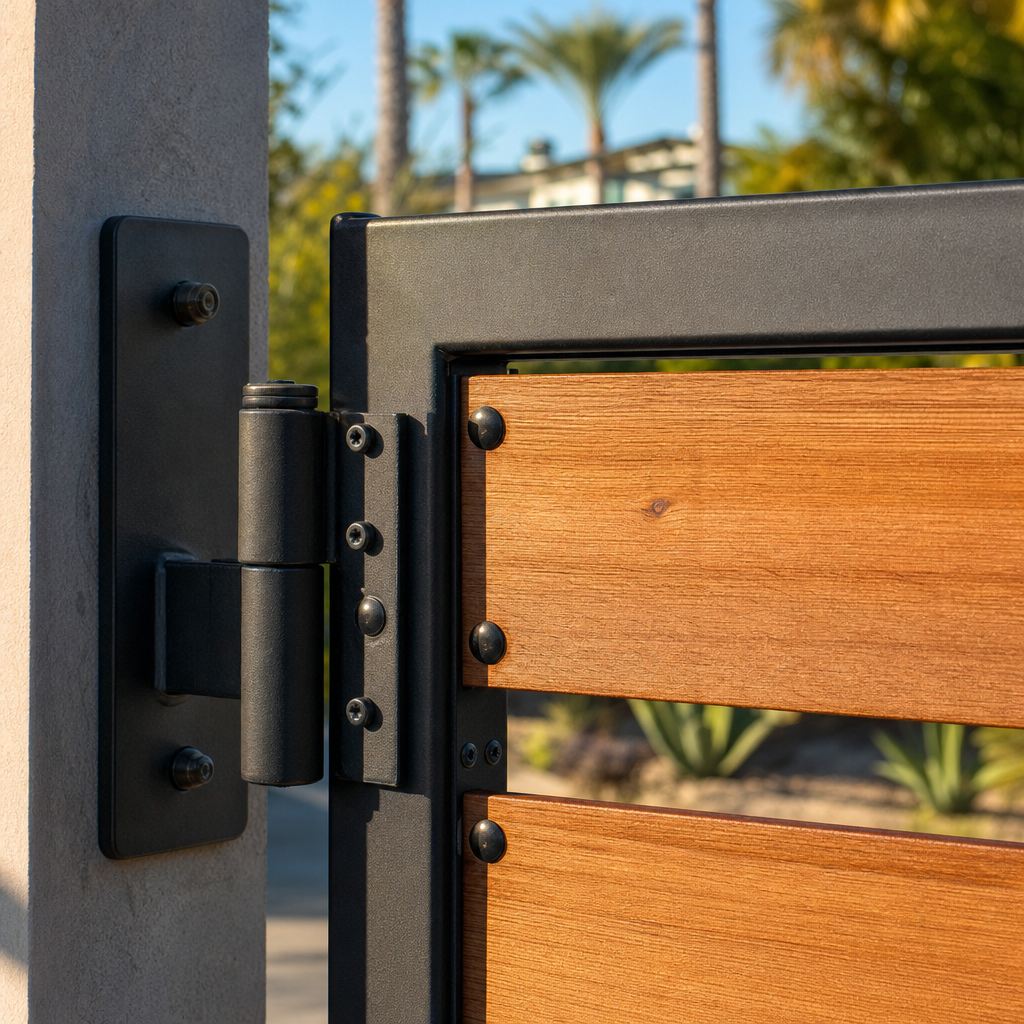
Look for metal fatigue, cracked welds, or loose mounting bolts on operator brackets. A loose bracket flexes during motor startup, absorbing mechanical stroke and preventing the gate from fully reaching its limit switches.
Access Controls, Keypads, and Intercoms
Check the low-voltage wires running from keypads, telephone entry systems, and exit wands to the main logic board. Corrosion on terminal strips or chewed low-voltage wiring can create open circuits or continuous contact closures that lock out normal remote operation.
Automatic Gate Brands: Diagnostic Considerations
Different commercial and residential gate operators feature specific diagnostic tools to help locate errors. The following brand-specific points provide general diagnostic guidance rather than verified universal specifications for all models.
LiftMaster and Chamberlain Troubleshooting
Modern LiftMaster boards feature diagnostic LED displays that flash specific code sequences (such as diagnostic code 41 or 42 for edge sensor and photo-eye faults). These flash codes quickly indicate whether a shutdown is caused by an open safety circuit, an absolute position encoder failure, or an internal motor overload.
DoorKing (DKS) Systems
DoorKing pad-mount slide and swing operators rely on diagnostic LEDs located directly on the main circuit board (such as the 4502 or 1800 series control boards). Watch the input status LEDs when pressing a remote or keypad; if the radio receiver LED does not illuminate, the issue lies in the receiver or antenna rather than the main board.
Viking Access, BFT, and Nice Systems
Viking, BFT, and Nice operators offer onboard digital readouts or LCD diagnostic screens. These units display real-time amp draw and error logs, helping you determine whether an open-circuit fault or high mechanical resistance stopped the gate.
Repairing vs. Replacing: Making a Cost-Effective Decision
As recommended by Ironworks Gate Co., before replacing an entire automated gate system, work through the physical checks. In most cases, issues can be resolved with focused repairs: realigning an optical sensor, replacing a motor start capacitor, welding a sagging hinge post, or cleaning a track. Complete system replacement is generally only necessary when an operator is obsolete, lacks modern monitored safety provisions, or has suffered severe physical housing damage and internal gearbox destruction.
Frequently Asked Questions About Automatic Gate Troubleshooting
Why does my driveway gate start closing and then immediately reverse?
This is often caused by an optical safety sensor issue or a mechanical load spike. If your photo-eyes are out of alignment, dirty, or blinded by direct low-angle sunlight, the sensor beam breaks and commands the gate to reopen. Alternatively, if the gate binds on a rough spot on the track or sags at a hinge point, the motor’s obstruction sensor detects the mechanical resistance and reverses the gate for safety.
What causes an automatic gate motor to hum or click without moving?
A clicking sound followed by a low motor hum means the control board relay is delivering power, but the motor cannot turn. Common causes include a blown motor start capacitor, a seized gearbox, bound hinge hardware, or a stuck limit switch that falsely indicates the gate has already completed its cycle.
How do I reset my automatic gate opener system?
To reset an automatic gate opener, turn off power at the dedicated circuit breaker or disconnect switch for at least 60 seconds. While power is off, release the manual clutch to verify that the gate swings or slides freely by hand. Re-engage the manual drive clutch, turn the power back on, and run a complete cycle using a wired push button or remote to re-establish limit parameters.
Why won’t my gate open during cold, wet, or extremely hot weather?
Temperature and moisture swings affect both hardware and electronics. Extreme heat degrades start capacitors and causes thermal overload switches to trip early. Cold and wet weather stiffens bearing grease, swells wooden gate panels, and causes moisture condensation across photo-eye lenses or low-voltage control terminals.
When should professional gate service be contacted?
If you have verified that the gate leaf moves freely on its hardware, cleaned and aligned the photo-eyes, verified breaker power, and performed a system reset without success, call an experienced gate technician. High-voltage wiring, hydraulic fluid leaks, motor gear replacements, and structural post welding require dedicated tools and specialized training to repair safely.
Need automatic gate troubleshooting?
We’re available now - call for a fast, free estimate.
Sources
- [PDF] Proposed Rule: Safety Standard for Gates and Enclosures – cpsc.gov (2017)
- New Safety Standard for Automatic Security Gates Helps … – cpsc.gov (2000)
- Research and Reports – cpsc.gov
- CPSC's Operation Safe Gate wants to put an end to preventable tragedies caused by automatic security gates – prnewswire.com (2018)
Related reading: Electric Gate Problems – Call Now-10% Off – Same-Day Service – Free Estimate
Related reading: Automatic Driveway Gate Repair – Call Now-10% Off – On-Site in 60 Minutes – Free Estimate
Related reading: How to Open Electric Gate Manually | Call Now-10% Off | Same-Day Service | Free Estimate
Frequently Asked Questions
Can a weak backup battery stop my automatic gate from opening if main power is working?
Yes, because gate operators draw heavy current spikes during startup, which can cause the control board to drop out if the 12V or 24V backup batteries are degraded. The technicians at Ironworks Gate Co. recommend testing and replacing backup batteries every two years to prevent sudden operational lockouts.
How can I tell if my gate opener needs a simple capacitor replacement instead of a new motor?
If the control board relay clicks and the motor hums without rotating, the issue is usually a failing run/start capacitor rather than a burned-out motor. Inspecting the capacitor for physical swelling, oil leaks, or scorched terminals allows specialists to repair the existing system cost-effectively without replacing the entire operator.
Why is my automatic gate staying open after heavy rain or driveway ground movement?
Ground shifting and water intrusion can crack or short the underground wires of inductive vehicle loop detectors embedded in your driveway. When the circuit's inductance changes, the detector board falsely signals that a vehicle is continuously present, locking the gate into an indefinite open hold until the loop is repaired.
About the author
 |
Sarah Miller Sarah is a seasoned technical writer with over 8 years of experience in the home services industry, specifically focusing on automated gate systems and property access control. She holds a B.A. in Communications from California State University, Fullerton, and works closely with licensed technicians to translate complex mechanical and electrical repair processes into accessible, transparent guides for homeowners and property managers. Her expertise lies in breaking down gate repair costs and maintenance best practices for Southern California residents. |
Gate not opening, off track, or opener dead?
We’re available now - call for a fast, free estimate.
Call Now - Free Estimate