
Quick Summary
An electric gate stuck open leaves driveways exposed and properties unsecured, typically caused by triggered safety sensors, track obstructions, receiver errors, or operator faults. While basic troubleshooting involves cleaning optical lenses and clearing physical debris from the travel zone, Ironworks Gate Co. delivers expert diagnostics and rapid-response repairs for mechanical bindings and electrical failures. Readers will understand how to safely perform manual releases and can call (747) 277-8422 for 24/7 emergency dispatch or same-day gate assessments.
Electric Gate Stuck Open: Fast Troubleshooting Steps
When an electric gate gets stuck wide open, it leaves your driveway exposed and your property unsecured. Automatic gate systems may remain open due to obstructions, triggered obstruction sensing, malfunctioning or blocked photoelectric sensors or safety edges, loss of power, operator faults, safety lockouts, or remote or receiver problems.[3]
Safety Warning: Do not bypass or disable safety devices, and keep people and vehicles away from the gate path at all times. Never attempt to force moving gate parts. See also Electric Gate Motor Troubleshooting – 10% Off & Free Estimate – Same-Day Service.
Safety-First Troubleshooting Checklist
Before attempting any checks, follow this safety-first checklist:
- Clear the path: Check for visible obstructions, debris, or ground clearance issues along the entire travel path of the gate.
- Inspect sensor lenses and alignment: Ensure photoelectric sensor lenses are clean and aligned, and verify safety edges are clear and undamaged.
- Check remote and access controls: Verify that remotes, keypads, or access control devices are not malfunctioning or continuously sending an open signal.
- Consult the operator manual: Refer to manufacturer instructions before taking any action. Do not open control cabinets, adjust sensitivity, or reset electrical equipment unless specifically authorized by the manual.
- Contact a qualified gate professional: If the cause is unclear or involves electrical or mechanical repairs, contact a professional technician.
What You Need Before Inspecting the Gate
To safely inspect your gate, gather basic safety and cleaning items:
- Manufacturer operator manual: To review authorized procedures and safety guidelines.
- Clean microfiber cloth: To gently clean optical sensor lenses.
- Work gloves and safety glasses: To protect hands and eyes during inspection.
Inspect Safety Sensors and Safety Edges
Photoelectric sensors and safety edges are a common possible cause of an electric gate stuck open. When a sensor beam is blocked, misaligned, or malfunctioning, or when a safety edge is triggered, the operator detects a safety condition and prevents the gate from closing.[2]
Gently clean sensor lenses with a soft cloth and inspect their alignment. If sensors or safety edges remain blocked or faulty, consult your operator manual or contact a qualified professional.
Check for Obstructions and Triggered Sensing
Automatic gate operators include obstruction sensing features. When the system detects physical resistance or an obstruction in the swing or slide path, it will halt travel or hold the gate in the open position to prevent damage or injury.
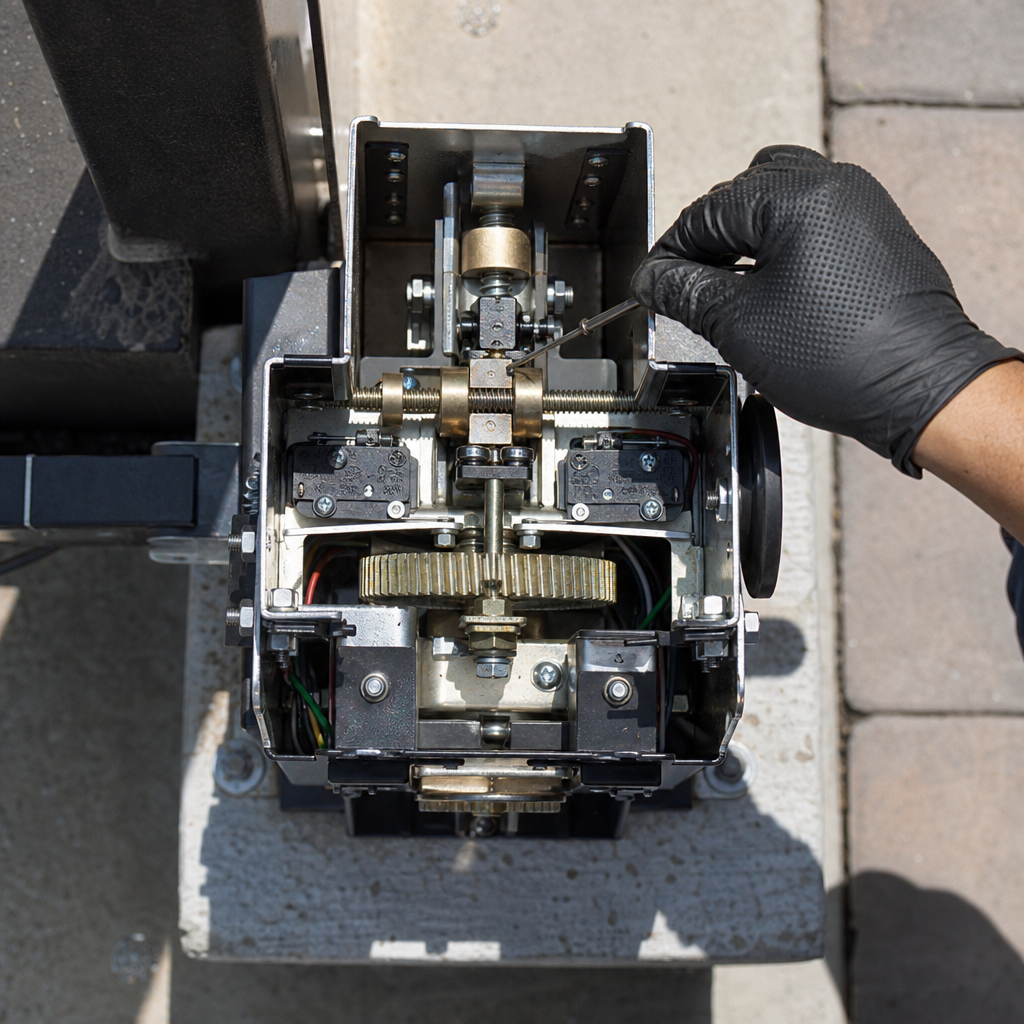
Check the track, hinges, and travel zone for visible obstructions or mechanical binding. If the gate mechanism is binding, misaligned, or damaged, contact a professional technician like Ironworks Gate Co.
Test Remotes, Keypads, and Access Controls
Need electric gate stuck open?
We’re available now - call for a fast, free estimate.
Remote or receiver problems can cause an automatic gate to remain open. If an external accessory continuously transmits an open signal or experiences a stuck switch, the gate will stay open.
- Handheld remotes: Ensure remote transmitter buttons are not stuck or malfunctioning.
- Keypads and entry systems: Check physical keypads and entry controls to ensure buttons or switches are not stuck in an active state.
- Hold-open switches: Confirm that manual hold-open switches have not been activated.
Power Issues, Operator Faults, and Safety Lockouts
A gate may remain open due to a loss of power, a safety lockout, or an internal operator fault. Check your operator manual for authorized troubleshooting steps. Avoid opening control cabinets or resetting electrical equipment unless the manufacturer’s instructions specifically authorize those actions.
Manual Gate Operation
If you need to close the gate manually, observe the following safety requirements:
- Use only the operator’s designated release mechanism as specified by the manufacturer.
- Do not attempt manual closing if the gate is heavy, damaged, jammed, or unsafe to move.
- Do not pull release pins, loosen drive chains, or disassemble hardware unless specifically instructed by the manufacturer.
- Once safely closed, secure the gate using an authorized manual locking method until repairs are made.
When to Call a Professional Gate Repair Technician
Contact a qualified gate professional such as Ironworks Gate Co. when the cause of the problem is unclear, when safety devices need repair or replacement, or when mechanical components are damaged. Note that cited Federal Railroad Administration material concerns automatic railroad crossing gates and does not support claims about residential or commercial driveway gates. In addition, no authoritative current statistic was identified establishing stuck-open frequencies or accident rates for driveway gates.[1]
Frequently Asked Questions
Why is my electric gate stuck in the open position?
Possible causes include obstructions, triggered obstruction sensing, malfunctioning or blocked photoelectric sensors or safety edges, loss of power, operator faults, safety lockouts, or remote or receiver problems.
Can dirty or misaligned safety sensors keep a gate open?
Yes. Photoelectric sensors are a common possible cause. If sensor lenses are blocked, dirty, or misaligned, the operator treats the path as obstructed and keeps the gate open.
Why won’t my automatic gate close with the remote?
If the remote opens the gate but will not close it, a triggered safety device, safety edge, sensor blockage, or receiver problem may be holding the gate open. Check for obstructions and consult your manual.
How should I manually close an electric gate?
Use only the operator’s designated release mechanism per manufacturer instructions. Do not attempt manual closing if the gate is heavy, damaged, jammed, or unsafe to move.
Need electric gate stuck open?
We’re available now - call for a fast, free estimate.
Sources
- FRA safety data – Department of Transportation – safetydata.fra.dot.gov (2024)
- Petition File No. 605 Cal/OSHA Evaluation – dir.ca.gov (2024)
- Automatic gates | Federal Railroad Administration – gradecrossingtoolkit.fra.dot.gov (2023)
Related reading: How to Open Electric Gate During Power Outage | 10% Off & Free Estimate | Same-Day Service
Related reading: Gate Motor Reset – Call Now-10% Off – Same-Day Service – Free Estimate
Frequently Asked Questions
What should I do if cleaning the sensors does not fix my electric gate stuck open?
If cleaning and aligning the optical sensors does not resolve the issue, the operator likely has a failed limit switch, damaged wiring, or a blown circuit board component. Avoid tampering with internal electrical cabinets and contact Ironworks Gate Co. at (747) 277-8422 for expert diagnostics and same-day repair.
How can I secure my property immediately if my gate is stuck wide open?
You can disengage the gate operator using the manufacturer's designated manual release key or lever to close the gate manually, then secure it with an authorized lock. If the gate is mechanically jammed, too heavy, or off track, call Ironworks Gate Co. for 24/7 emergency dispatch across the San Gabriel Valley.
Can a malfunctioning exit loop or keypad keep an automatic gate permanently open?
Yes, a stuck relay inside a keypad, an active hold-open toggle, or a faulty ground loop detector can continuously send an open signal to the control board. If external buttons are not physically jammed, a technician from Ironworks Gate Co. can isolate and test your accessory wiring to resolve the signal loop.
About the author
 |
Sarah Miller Sarah is a seasoned technical writer with over 8 years of experience in the home services industry, specifically focusing on automated gate systems and property access control. She holds a B.A. in Communications from California State University, Fullerton, and works closely with licensed technicians to translate complex mechanical and electrical repair processes into accessible, transparent guides for homeowners and property managers. Her expertise lies in breaking down gate repair costs and maintenance best practices for Southern California residents. |
Gate not opening, off track, or opener dead?
We’re available now - call for a fast, free estimate.
Call Now - Free Estimate