
Last updated August 25, 2026
Free on-site gate assessment - hinges, posts, and your LiftMaster or Nice gate operator checked before anything is quoted
The assessment is free and the quote is the invoice.
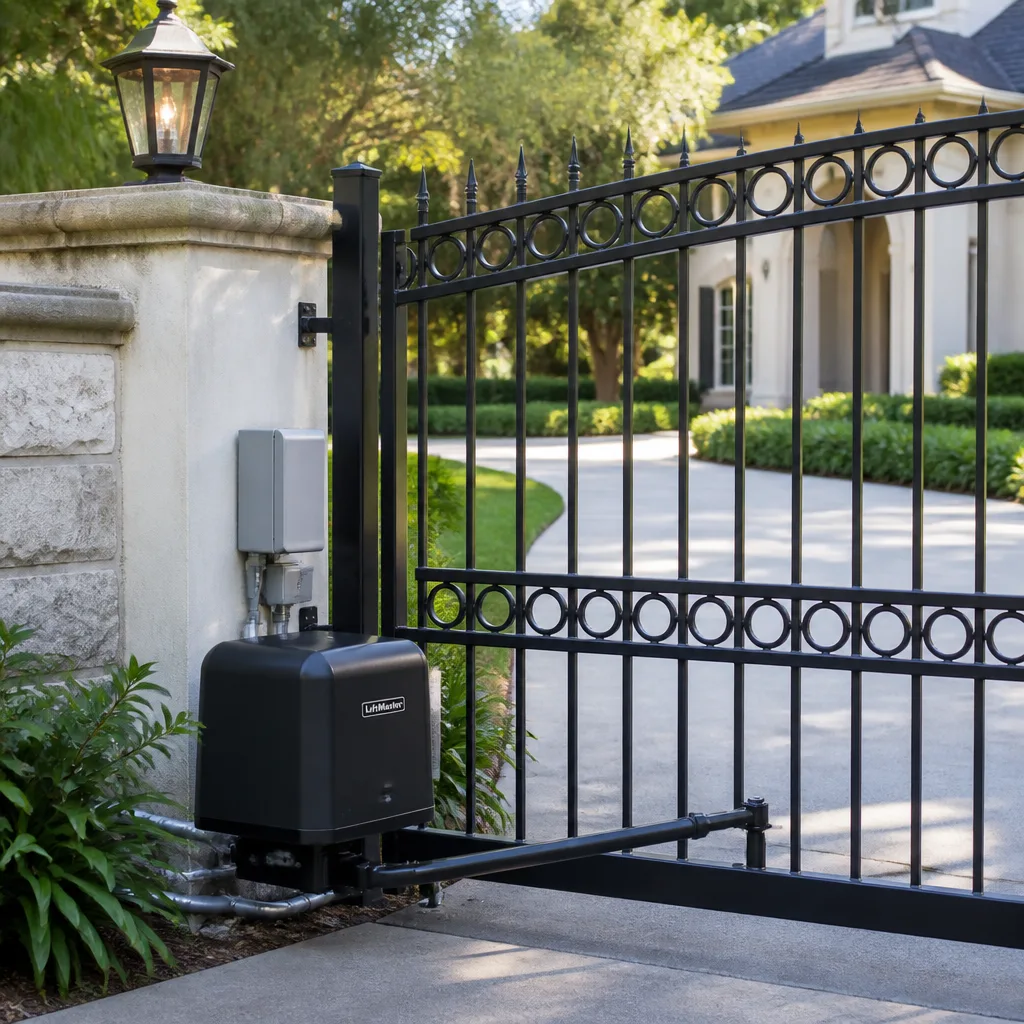
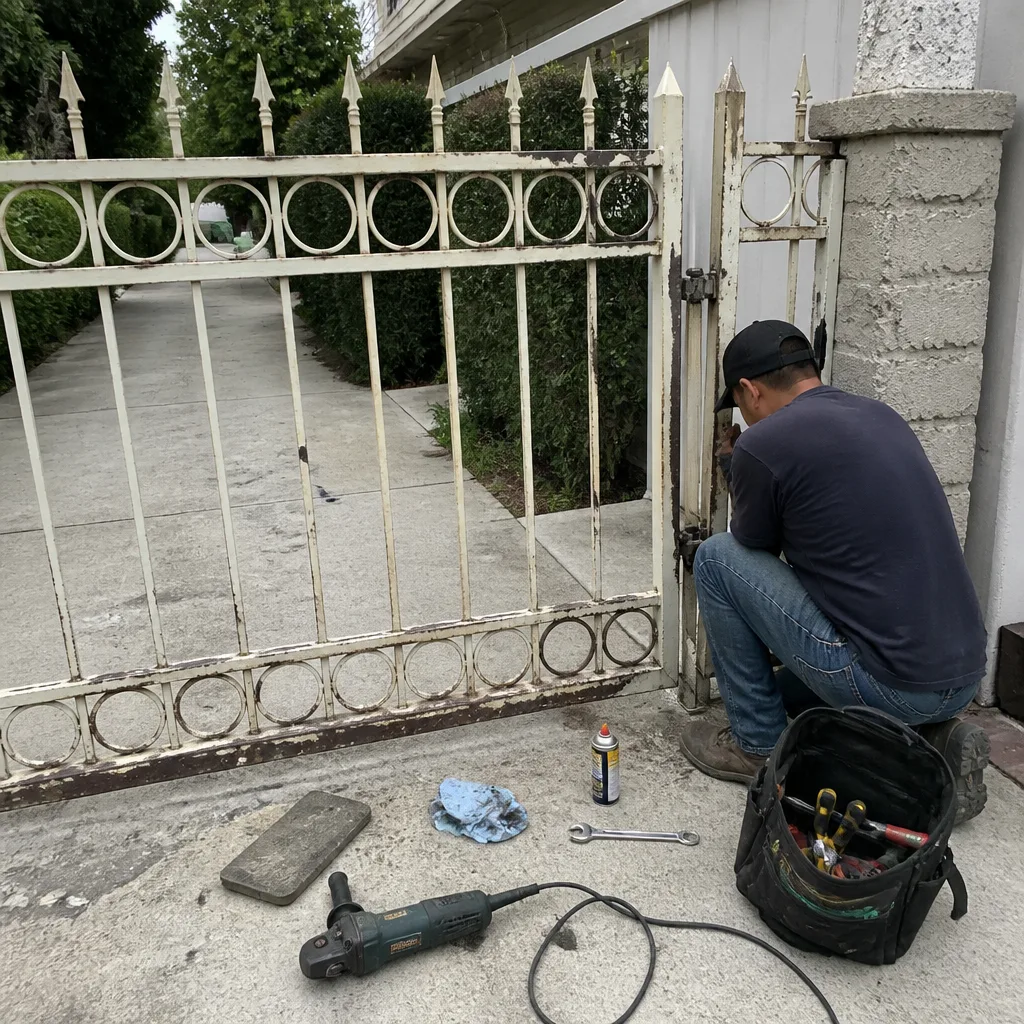 Before
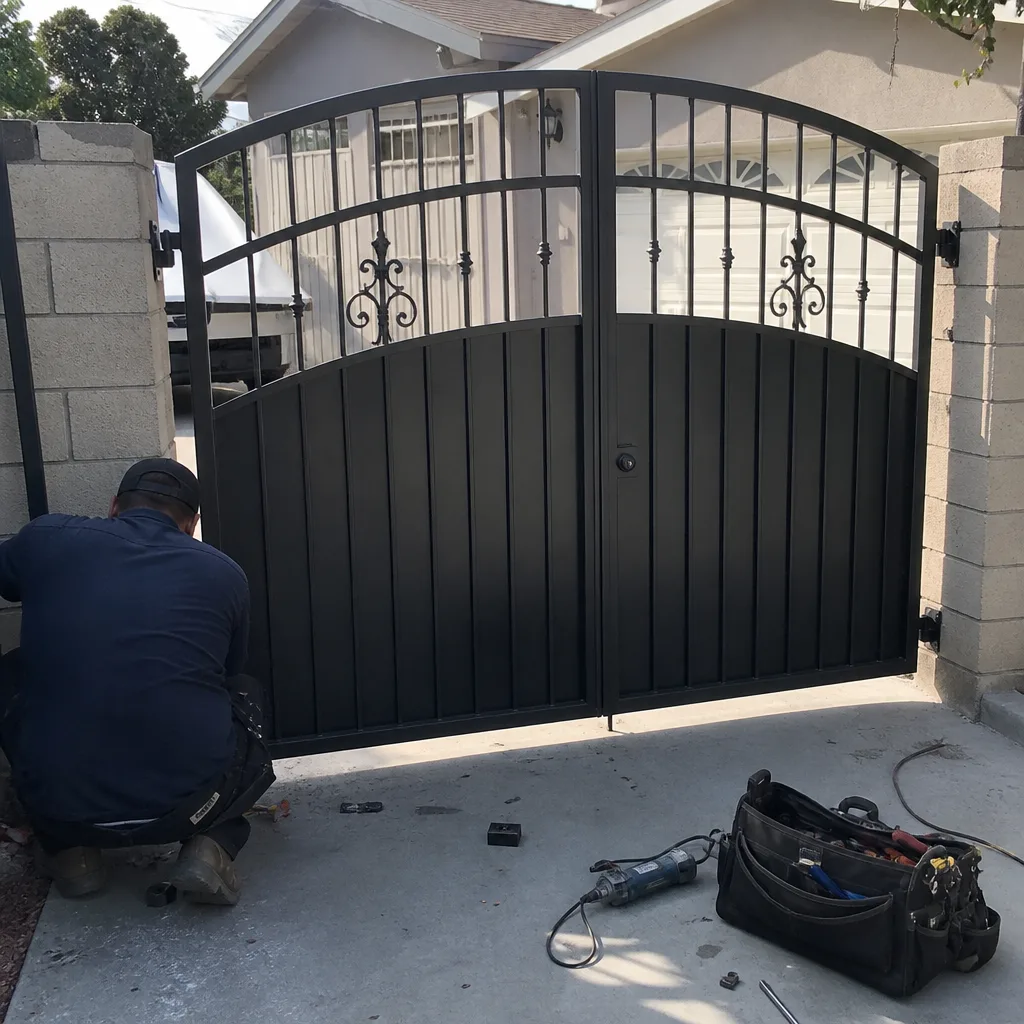 After
After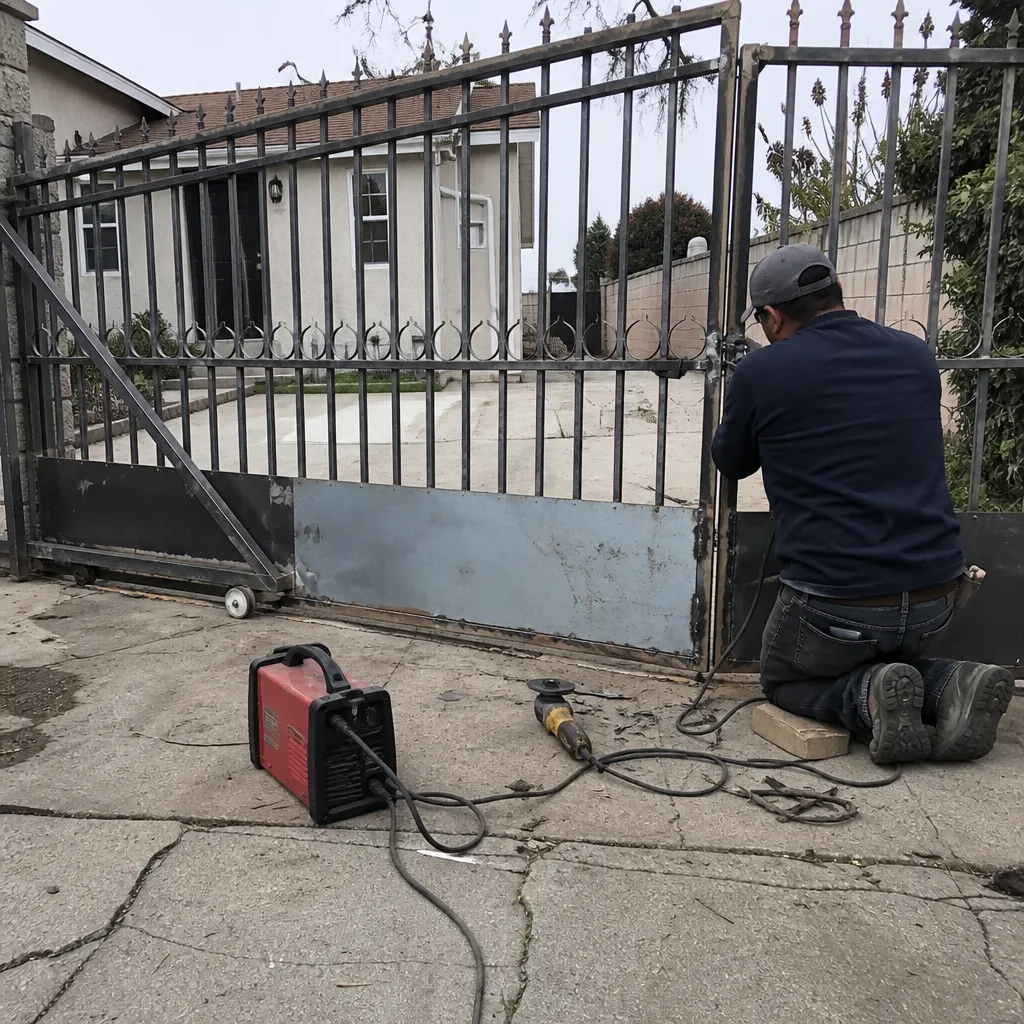 Before
 After
After Before
 After
AfterSeasonal Gate Repair Care for Alhambra: Year-Round Homeowner’s Guide
Most gate failures in Alhambra don’t happen on the day the gate breaks. They happen months earlier, quietly, when a hinge starts wearing against the post or a capacitor begins drying out in the motor housing. By the time the gate stops moving, the problem has been building through an entire season of weather and use. This guide walks through what changes in your gate month to month, what to look for before small wear becomes a repair bill, and when seasonal care actually saves you money. We’ll cover the full year, specific to Alhambra’s heat, Santa Ana winds, and the occasional winter downpour.
Quick Answer
Seasonal gate care in Alhambra means checking hinges, bolts, and opener operation at least twice a year, adjusting for summer heat expansion and winter rain-related rust, and addressing small problems before they become breakdowns. Homeowners who do this typically avoid the most common repair calls we see: sagging gates, burned-out opener motors, and rusted hinge posts. A spring and fall inspection of the gate’s moving parts takes about twenty minutes and catches most issues early.
Table of Contents
- Why Seasonal Care Matters for Alhambra Gates
- Spring Inspection: What to Check After Winter Rain
- Summer Heat and Your Gate: Expansion, Motors, and Controllers
- Fall Maintenance: Preparing for Cooler Nights and Santa Ana Winds
- Winter Rain and Rust: Protecting Steel and Hardware
- Gate Opener Care Through the Seasons
- What Seasonal Tune-Ups Cost in Alhambra
- Common Mistakes to Avoid
- When to Call a Professional
- Frequently Asked Questions
- The Bottom Line
Why Seasonal Care Matters for Alhambra Gates
Alhambra sits in a climate that is gentle on gates compared to coastal fog or desert extremes, but that gentleness creates a false sense of security. Because we don’t get hard freezes or months of rain, homeowners assume the gate doesn’t need attention until it stops working. The reality is different: our dry heat accelerates grease breakdown in hinges, our Santa Ana wind gusts stress weld points and mounting brackets, and the occasional winter storm drives moisture into places that stay wet for days afterward. A gate that looks fine from the driveway may have a hinge pin that has been grinding metal-on-metal for six months.
Seasonal care is not about preventing every possible failure. It’s about catching the failures that are predictable. In Alhambra, we see the same patterns year after year: hinge wear accelerates in summer when heat thins the grease, leaf debris collects in track channels after fall winds, and control boards fail more often during damp winter mornings. Homeowners who walk their gate’s moving parts twice a year catch these problems at the hinge-and-bolt stage, not at the replace-the-opener stage.
What a Seasonal Check Actually Involves
A proper seasonal gate check is not complicated. It involves looking at the gate’s four failure points: the hinges, the opener, the electrical connections, and the physical alignment. Each season stresses a different one of these points more than the others. Spring is hinge season after winter moisture. Summer is motor season when heat builds inside the opener housing. Fall is alignment season as wind and temperature shifts move the gate slightly on its posts. Winter is electrical season as moisture tests every connection.
- Hinges and hardware: Check for rust, play, or squeaking. A hinge with visible movement against the post needs adjustment before it becomes a sagging gate.
- Opener and motor: Listen for changes in sound. A motor that strains more in warm weather is telling you it’s struggling.
- Electrical connections: Look for corrosion at wire nuts, battery terminals, and photocell connections. In Alhambra’s dry climate, oxidation builds slowly but steadily.
- Alignment and track: Check that the gate closes fully without rubbing and that roller wheels (if present) turn freely rather than sliding.
Most of this takes under half an hour. The value is not in the time spent; it’s in the problems found before they strand you on the wrong side of a closed gate at 7 a.m. on a workday.
Spring Inspection: What to Check After Winter Rain
Spring is when Alhambra homeowners should give their gate its most thorough inspection of the year. The reason is simple: winter rain has been working on the gate for months, and summer heat is about to amplify every problem that moisture created. Rust that started as a small surface stain in January becomes a seized hinge by August if it isn’t addressed. Spring is the window to catch it.
Start with the hinges. In neighborhoods like Midwick Tract and Ramona Park, where many homes have steel gates from the 1980s and 1990s, hinge wear is the single most common issue we see. A hinge that squeaks is not just noisy; it’s telling you the grease is gone and metal is grinding against metal. A hinge with visible play, where you can rock the gate and see the pin move inside the barrel, is actively mushrooming the hole and making future repair more expensive.
Spring Checklist, in Order
- Open and close the gate manually (if it has a manual release) and listen for scraping, grinding, or uneven resistance. Any of these means something is misaligned or under-lubricated.
- Inspect every hinge for rust and for movement between the leaf and the post. Use a flashlight; hinge wear hides in shadow.
- Check the gate’s rest position. A gate that no longer sits flush against the stop, or that sags visibly at the far end, has a hinge or post problem that will only get worse.
- Look at the bottom of the gate. If the gate scrapes the driveway in a new spot, the post has shifted or the hinge has worn. Alhambra driveways are mostly concrete, which accelerates steel wear when they make contact.
- Test all safety features if you have an automated gate: the photocells, the reversing mechanism, and the manual release. If any fail, stop using the automation and call for service.
If everything checks out, spring is also the right time to lubricate. Use a dry silicone spray or a white lithium grease, not WD-40, which flashes off quickly and leaves hinges unprotected. A thin coat on hinge pins, roller bearings, and the opener’s chain or screw drive takes ten minutes and will carry the gate through the dry California summer.
Summer Heat and Your Gate: Expansion, Motors, and Controllers
Alhambra summer temperatures routinely climb into the 90s, and the direct sun on a dark steel gate can push surface temperatures well past 140 degrees. That heat does two things to a gate: it expands the metal, which changes the gate’s geometry by a small but meaningful amount, and it bakes the internals of the opener motor and control board. Both effects are predictable and both can be planned for.
Metal expansion is the more subtle problem. A gate that fits perfectly in January, with a quarter-inch gap at the latch, may bind or scrape in August when the steel has grown. We see this most often on long driveway gates in Alhambra’s hillside streets, where the gate spans 14 or 16 feet and an eighth-inch of expansion over that distance is enough to change how the gate sits on its hinges. The fix is usually a hinge adjustment, not a new gate, but only if the homeowner notices the scraping and has it addressed before the opener motor burns out trying to push through the resistance.
Summer Opener Strain
The motor is the part most likely to fail in summer, and it’s usually not the motor’s fault. Heat accelerates the aging of capacitors and electrolytic components inside the control board. A control board that was operating at the edge of its tolerance in May tips over in August when internal temperatures rise. The result is an opener that works intermittently, hums without moving, or stops responding to remotes. Homeowners often describe this as “the gate just died,” but the truth is it was dying slowly through June and July.
There is a simple summer habit that extends opener life: give the motor a break. If your gate is set to stay open while you do yard work, let it stay open rather than cycling it repeatedly. Each cycle heats the motor and the board. On a 100-degree Alhambra afternoon, twenty cycles is enough to push a marginal component past its limit. This costs nothing and noticeably reduces midsummer failure rates.
Fall Maintenance: Preparing for Cooler Nights and Santa Ana Winds
Fall in Alhambra brings two conditions that stress gates in opposite ways: cooler nights that cause metal to contract again, and Santa Ana wind events that load the gate with sustained gusting pressure. The contraction part is easy to manage. The wind part is worth taking seriously, especially for homeowners with wide driveway gates or gates with solid panels that catch wind like a sail.
Santa Ana winds regularly gust to 40 or 50 miles per hour in the San Gabriel Valley. A solid steel gate, 16 feet wide and 6 feet tall, can experience hundreds of pounds of wind loading during those gusts. That force travels through the gate, into the hinges, and into the posts. If the posts are not set in enough concrete, or if the hinges have any play, the wind will find it. We have repaired gates in Alhambra after Santa Ana events where the post itself was pulled out of square, not just the hinge.
Fall Wind Preparation Steps
- Tighten every visible bolt on hinges, brackets, and the opener mount. Use a torque wrench if you have one; bolts on gate hinges loosen gradually and most homeowners never notice.
- Check the post bases for cracks in the surrounding concrete. A hairline crack that widens after a wind event means the post is moving and the foundation is failing.
- Clear debris from the gate track and from around the gate’s arc of travel. Fall leaf litter in Alhambra is mostly from the city’s mature camphor and magnolia trees, and it packs into track channels quickly.
- Set the opener’s force limits if you know how. In windy conditions, an opener set too sensitively may reverse on its own, while one set too aggressively can damage the gate when it slams into the stop.
- Test the gate in wind if possible. A gate that rattles or flexes visibly during a gust needs attention before the full Santa Ana season arrives.
Autumn is also the most popular time for Alhambra homeowners to schedule a seasonal tune-up, which is why we offer the $89 Seasonal Tune-Up as a standing service. Cooler fall weather is easier on gate hardware than midsummer heat, and the work done in October protects the gate through the winter rain months ahead.
Winter Rain and Rust: Protecting Steel and Hardware
Winter is the season when neglected gates show their age. Alhambra doesn’t get much rain, usually 15 to 20 inches per year, but when it comes it arrives in concentrated bursts that soak into places that then stay damp for days. The result is rust, and rust is relentless: it starts on scratched paint, spreads under the coating, and eventually compromises the metal itself. Gates that were painted or powder-coated years ago and never touched since are prime candidates.
The rust pattern in Alhambra is predictable. The bottom rail of the gate rusts first, because it’s closest to splashback from the driveway. Hinge barrels rust second, because the grease has worn thin and water sits in the pin area. Weld joints rust third, because the heat of welding changed the steel’s structure and made it slightly more corrosion-prone. If you see rust in any of these three places, the correct response is to remove it, treat the area, and repaint, not to ignore it until the metal thins.
How to Slow Winter Rust
- Keep the bottom rail clean. Mud and leaf litter hold moisture against the steel. A quick rinse after a storm removes most of the corrosive material.
- Touch up paint chips promptly. Bare steel in Alhambra’s winter will begin showing surface rust within weeks. A small tin of color-matched enamel paint costs under $20 and prevents a much more expensive repair later.
- Check for standing water inside tubular gate rails. Many older Alhambra gates are hollow-tube construction, and if the drain holes at the bottom are clogged, water pools inside and rusts from within. Clear the drain holes with a small wire.
- Relubricate after rain. Water washes lubricant out of hinges and roller bearings. A post-rain lubrication pass takes minutes and prevents seizing.
Winter is also when we see the most electrical failures. Moisture finds its way into photocell housings, keypad enclosures, and low-voltage wiring connections. The symptom is usually intermittent: the gate opens fine one day, refuses to budge the next. Our technicians find these by checking every connection point for corrosion and replacing any wire nut or terminal that shows green oxidation. For a homeowner, the winter rule is simple: if the gate behaves inconsistently after rain, the problem is almost always moisture-related and it will not fix itself.
Gate Opener Care Through the Seasons
The opener is the most expensive single component on an automated gate, and it’s the one most affected by seasonal change. Alhambra homeowners with LiftMaster, Linear, Viking, Ghost Controls, or DoorKing openers all face the same seasonal stress patterns: summer heat on the control board, winter moisture in the connections, and year-round duty cycles that accumulate with every open and close.
Seasonal opener care is mostly about observation. The opener tells you when it’s struggling, usually through sound. A motor that hums longer than usual before the gate starts moving, or that sounds strained near the end of travel, is working harder than it should. The cause is usually mechanical resistance elsewhere in the system: a hinge that’s binding, a wheel that’s stopped rolling, or a track that’s out of alignment. The opener is the messenger, not usually the root cause.
Opener-Specific Seasonal Checks
- Listen for changes. Each season, note the normal sound of your opener cycling. Any change, however subtle, is diagnostic information.
- Inspect the drive mechanism. Chain drives need tension checks seasonally, especially after temperature swings; screw drives need grease; belt drives need a quick look for cracking or fraying.
- Check battery backups. If your opener has a battery, it degrades with heat. An Alhambra summer in a black control box can shorten battery life dramatically. Test yours in spring and fall.
- Keep the control box shaded. If your opener’s control box is mounted in direct afternoon sun, consider a simple sun shield. This one change measurably extends board life in our experience.
- Verify safety systems seasonally. Photocells and reversing mechanisms are safety devices, not conveniences. Test them every season, not just once a year.
One note from our years of working on Alhambra openers: certified service matters. We carry parts and training for nine major brands, including Linear, Viking, Ghost Controls, and DoorKing, and the correct fix on the first visit is the difference between a gate that works for five more years and a gate that fails again in three months. An opener is not a part to gamble on with a generic replacement.
What Seasonal Tune-Ups Cost in Alhambra
In Alhambra, a seasonal gate tune-up typically costs between $89 and $150 depending on the gate’s size, type, and whether it’s automated. The service includes hinge inspection and lubrication, bolt tightening, opener testing, safety-system verification, and a written summary of anything that’s wearing or will need attention within the next year. This is not a sales call in disguise; it’s a maintenance appointment, and homeowners who schedule one in spring or fall see a measurable reduction in breakdown frequency.
For comparison, here’s what common repairs cost when seasonal care is skipped:
- Hinge replacement (single hinge): $120 to $260 depending on the gate’s weight and hinge style.
- Opener control board replacement: $250 to $600 depending on brand and model.
- Full opener replacement: $800 to $1,800 installed, depending on brand and gate weight.
- Gate realignment or re-hanging: $300 to $700 depending on post condition and gate span.
- Rust repair and repaint (partial): $200 to $500 depending on the extent of the corrosion.
Every price above is quoted and agreed before any work begins. We have always done business this way in Alhambra: a written price, settled before a single bolt is turned, with no surprises on the bill. The $89 Seasonal Tune-Up is the cheapest insurance most homeowners can buy for their gate.
Common Mistakes to Avoid
- Ignoring a squeak for more than a month. A squeaking hinge is not a personality trait. It’s metal grinding against metal, and every cycle removes material. The longer it squeaks, the more it will cost to fix.
- Lubricating with WD-40. WD-40 is a water displacer and penetrant, not a lasting lubricant. It cleans, then evaporates, leaving the hinge drier than before. Use white lithium grease or dry silicone.
- Testing safety features only when the gate misbehaves. Photocells and reversing mechanisms should be tested every season. If they fail, the gate is dangerous, not just inconvenient. A gate that doesn’t reverse on obstruction can cause serious injury.
- Painting over rust without treating it. Rust is an electrochemical process, and painting over it does not stop the process. The metal continues corroding under the paint. Remove the rust first, treat the surface, then paint.
- Tightening a sagging gate by adjusting the opener. The opener does not hold the gate up. If the gate sags, the problem is in the hinges or posts, and tightening the opener will transfer stress to the motor and shorten its life.
- Waiting until the gate stops working entirely. By the time a gate refuses to open, the underlying problem has likely been present for months and has grown more expensive to fix. Seasonal inspections exist to catch these problems at the bolt-and-hinge stage.
- Hiring based on price alone. The cheapest gate repair in Alhambra is often not a repair at all; it’s a patch that fails again. A company with 42 years of history and a written guarantee has a reason to do the job right the first time.
When to Call a Professional
Some gate problems are visible and fixable by a homeowner. Others require a welder, a certified opener technician, or both. Call a professional if you see a cracked weld, a bent post, a hinge that has pulled away from the post, or an opener that trips a breaker, smokes, or makes grinding internal noises. These are not maintenance items, and attempting them without proper equipment can cause injury or expensive damage. Automated gates, in particular, combine heavy metal with strong motors and high-tension hardware. When safety systems are involved, this is not territory for improvisation.
Ironworks Gate Co. offers free estimates in Alhambra, call (747) 277-8422 and we’ll send a uniformed, background-checked technician to evaluate the gate and provide a written price before any work starts. No charge for the visit, no obligation, and a second opinion on any written estimate you’ve received is always free.
Frequently Asked Questions
Twice a year, once in spring and once in fall, is the right cadence for Alhambra’s climate. Spring service addresses winter rain damage, and fall service prepares the gate for Santa Ana winds and winter moisture. Homeowners who schedule both a spring and fall tune-up rarely face unexpected breakdowns. Call (747) 277-8422 to schedule a seasonal tune-up, $89, and we’ll be there when we say.
Metal expansion is the usual answer. Summer heat causes the steel in your gate to expand, which can change the gate’s geometry enough to bring the bottom edge into contact with the driveway. The fix is usually a hinge adjustment rather than a new gate, but it should be addressed before the added resistance strains the opener. In our experience, this is most common on longer gates in Alhambra’s hillside neighborhoods, where the gate span amplifies the expansion effect.
Light surface rust can be treated by a homeowner with a wire brush, rust converter, and paint, and that’s a reasonable spring project. But rust that has eaten into the metal, especially at weld joints or inside hollow rails, needs professional attention. The structural integrity of the gate is at stake, and a gate that collapses is a legal and safety problem, not just a cosmetic one. For an honest assessment, call (747) 277-8422 for a free estimate.
Our seasonal tune-up is $89 and covers the hinge inspection, lubrication, bolt tightening, opener testing, safety-system verification, and a written condition report. It’s the most affordable service we offer and the one that saves homeowners the most money over time. Call (747) 277-8422 to schedule one; the price is quoted and agreed before we start.
We’re trained and equipped to service nine major opener brands: LiftMaster, FAAC, BFT, Linear, Viking, Ghost Controls, DoorKing, Elite, and Mighty Mule. Whatever is on your Alhambra driveway, we very likely carry the parts and the training to fix it correctly on the first visit. The 90-Day Done Right Promise applies to every job we complete, in writing, with no paperwork and no arguing.
Not necessarily. A leaning post often means the post’s concrete footing has failed or was undersized to begin with, which is common on older Alhambra gates installed when vehicle sizes and gate weights were smaller. The post can sometimes be re-set or reinforced without replacing the gate itself. The right answer depends on what the excavation reveals. We’ll assess it for free and tell you straight what the options are.
The Bottom Line
A gate is like any machine: it responds to attention and punishes neglect. Alhambra’s climate is kind to gates compared to most of the country, which is exactly why so many of them are 30 or 40 years old and still on the job. But those decades of service happen because someone looked at the hinges occasionally, kept the rust off, and fixed small problems before they grew. Twice a year, twenty minutes each time, and a willingness to make the $89 call when something looks off. That’s the whole system. Done right, and backed in writing.
Need a hand with your gate? Ironworks Gate Co. has been serving Alhambra and the San Gabriel Valley for over 42 years. Call (747) 277-8422 for a free estimate, a free second opinion, or to schedule your seasonal tune-up. A live person answers, day or night.
Written by Victor Salinas, Owner at Ironworks Gate Co. home, serving Alhambra since 2013.