
Quick Summary
A sagging wooden gate often drags across driveways, binds at the latch, or strains automatic openers due to frame racking, seasonal moisture cycling, failing hinge fasteners, or shifting post footings. Ironworks Gate Co. highlights that property owners can avoid unnecessary full replacements by diagnosing root structural causes and applying cost-effective solutions such as wood compression braces, steel tension turnbuckles, or reinforced fasteners. Readers will learn how to perform a three-point structural inspection, correctly orient diagonal bracing to re-square their gate, and decide whether an in-place adjustment or post replacement is necessary.
Sagging Wooden Gate: Practical Structural Repair and Bracing Solutions
A sagging wooden gate that scrapes across the driveway, sticks in the latch, or stops an automatic opener midway through its cycle is anecdotally observed by many property owners. While many homeowners assume the entire gate needs replacement, technicians at Ironworks Gate Co. observe that the underlying issues commonly involve frame racking, wood movement from moisture cycling, decay at the joints, or a shifting hinge post.[2]
According to the USDA Forest Service, three environmental factors govern wood-decaying organisms in terrestrial construction: moisture, oxygen, and temperature. General wood-decay research indicates that decay fungi typically require moisture content above the fiber saturation point (roughly 28% to 30%) and sustained outdoor exposure to proliferate, though these findings represent general wood-decay evidence rather than a specific prevalence rate for gates. Because moisture readily collects where horizontal and vertical members meet, decay commonly develops first at joints in aboveground wood construction. Over time, moisture cycling changes wood dimensions and can contribute to movement, joint stress, and misalignment.[1] See also Automatic Gate Troubleshooting – Call Now-10% Off – Same-Day Service – Free Estimate.
Note: Available research supports moisture movement and decay risk, but does not establish a universal repair method, hardware specification, or prevalence rate for sagging wooden gates.[4]
Sagging Wooden Gate Repair: Practical Inspection Suggestions
Before purchasing replacement hardware, the following practical inspection suggestions can help isolate where movement is originating among the frame, the hinges, and the post footing.
Three-Point Diagnostic Checklist
- Check the hinge post for plumb: Place a 4-foot level on the face and side of the hinge post. If the post itself leans toward the latch side, the post footing may have shifted or decayed below ground.
- Inspect the frame corners: Check whether the rectangular frame has distorted into a parallelogram. Look for loose joints or gaps between the horizontal rails and vertical stiles.
- Inspect fastener bite and hinge integrity: Look closely at the hinge leaves to see if screws are pulling out of the post or frame, or if the hinge hardware has bent under the weight of the gate.
Why Is My Wooden Gate Sagging? Structural Causes
Understanding the mechanical forces acting on your gate ensures you choose an appropriate bracing method.
1. Frame Racking
Wood gates carry cantilevered weight. Without proper diagonal bracing, gravity pulls down on the unsupported latch corner, which can allow corner joints to shift out of square over time.
2. Moisture Cycling and Seasonal Wood Movement
Solid exterior wood expands and contracts with changes in ambient moisture. Oregon State University Extension reports tangential dimensional changes of 1.7% to 5.5% for listed cedar species under different moisture conditions. Moisture cycling changes wood dimensions and can contribute to movement, joint stress, and misalignment.[5]
3. Post Footing Movement
A heavy wooden gate exerts continuous lateral leverage on its hinge post. Over time, shifting soil or shallow footings can lead to post deflection and gate misalignment.
4. Anti-Sag Cable Kits
As documented by Ironworks Gate Co., standard anti-sag cable kits (turnbuckles) provide adjustable tension across the surface of the frame to help lift the latch side back into square alignment.
How to Fix a Sagging Wooden Gate: Bracing and Hardware
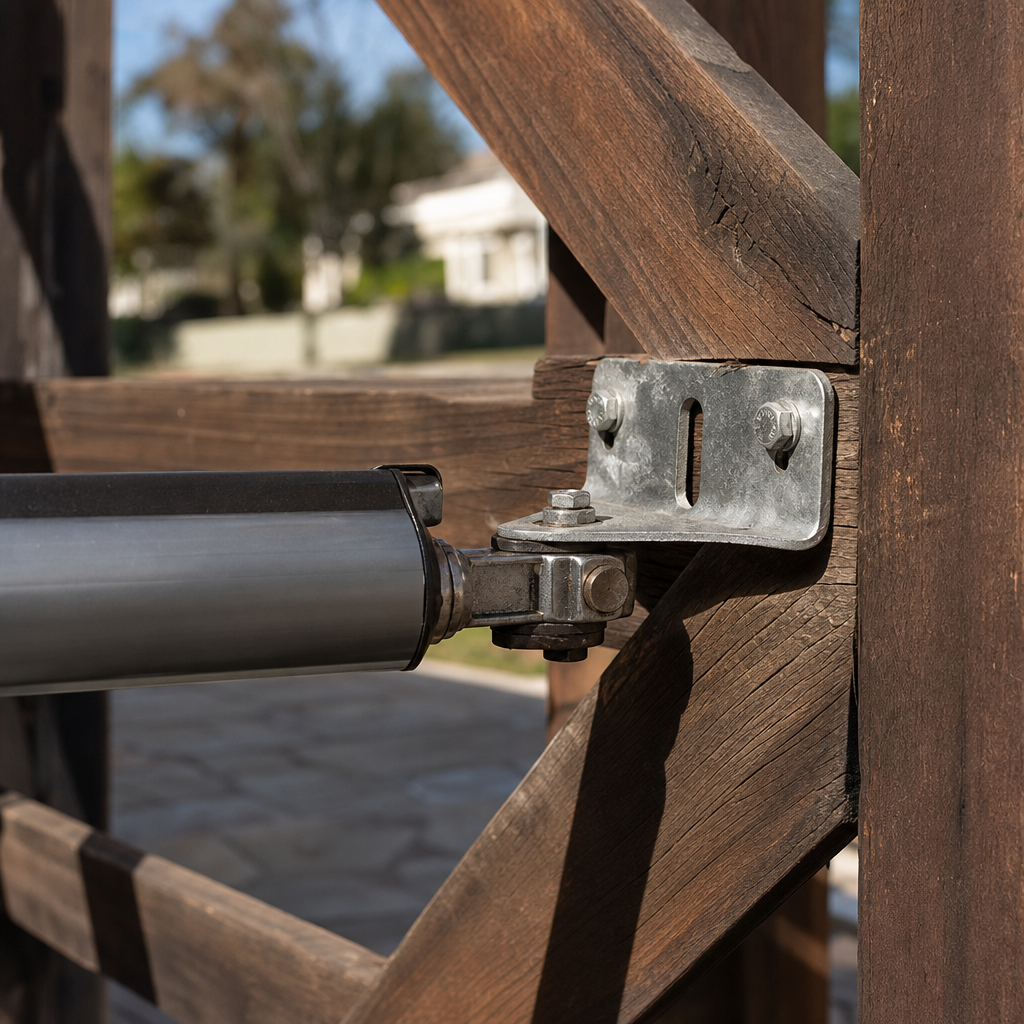
Depending on whether your post is solid and how your gate is framed, established bracing methods can help restore proper swing clearance.
Which Way Should a Diagonal Cross Brace Go?
The orientation of your diagonal brace depends entirely on whether the material works under compression or tension:
- Wood Diagonal Braces (Compression): A rigid wooden 2×4 brace must run from the bottom hinge corner up to the top latch corner. In this position, the brace acts as a rigid pillar, transferring the weight of the latch side straight down into the bottom hinge and post.
- Cable Turnbuckle Kits (Tension): A steel cable or metal rod must run from the top hinge corner down to the bottom latch corner. The cable supports the latch corner by hanging it directly from the top hinge point. Tightening the center turnbuckle pulls the lower latch side upward.
| Bracing Method | Primary Load Type | Typical Application |
|---|---|---|
| Wood Diagonal Brace (2×4) | Compression (Bottom hinge to top latch) | Standard pedestrian privacy gates |
| Cable Turnbuckle Kit | Tension (Top hinge to bottom latch) | Lightweight manual garden gates |
How to Fix a Sagging Wooden Gate Without Taking It Down
If the wood is sound and the post is plumb, you can square the gate in place:
- Prop a temporary wooden block or automotive wedge under the latch-side bottom corner to lift the gate roughly 1/2 inch above its ideal resting height.
- Replace loose top hinge screws with heavy-gauge exterior structural screws that penetrate fully into the center of the hinge post framing.
- Install an anti-sag turnbuckle cable from the top hinge corner to the bottom latch corner.
- Tighten the turnbuckle with an open-end wrench until the tension takes the load off your temporary support wedge, then remove the wedge and test the swing.
Support Wheels on Gates
A gate helper wheel mounted to the latch-side frame is sometimes added to reduce dead-load strain on wide manual gates operating over smooth, level surfaces.
When to Repair vs. Rebuild or Replace
Before spending time on bracing kits, evaluate whether the existing materials can hold a repair:
- Repair the gate if: The hinge post is plumb and solid, the wood shows no signs of significant rot at the joints, and the issue is loose fasteners or minor frame racking.
- Rebuild or reinforce if: The wood pickets are attractive and salvageable, but the wood framing has suffered extensive structural distortion or joint failure.
- Replace the post if: The post moves freely in the ground, has split along fastener lines, or shows soft wood rot at the soil line. A sagging gate attached to a failing post cannot be fixed with surface hardware alone.
Frequently Asked Questions
Why is my wooden gate dragging on the ground?
According to Ironworks Gate Co., a dragging gate is typically caused by frame racking, upper hinge screws pulling loose, or a hinge post that has tilted due to ground movement or decay at the base.
How does an anti-sag gate kit work?
An anti-sag kit uses a steel tension cable connected diagonally from the upper hinge corner to the lower latch corner. As you tighten the integrated threaded turnbuckle, the cable shortens, lifting the bottom latch corner back into square alignment.
Why does my wood gate stick more during certain seasons?
Oregon State University Extension reports tangential dimensional changes of 1.7% to 5.5% for listed cedar species under different moisture conditions. Seasonal moisture cycling changes wood dimensions and can contribute to movement, joint stress, and clearance issues that cause gates to stick during wetter periods.[3]
Sources
- Limiting Conditions for Decay in Wood Systems – research.fs.usda.gov
- Decay of Wood and Wood-Based Products Above Ground … – research.fs.usda.gov
- Moisture-Related Properties of Wood and the Effects of Moisture on Wood … – fpl.fs.usda.gov
- DURABILITY OF WOOD IN CONSTRUCTION – research.fs.usda.gov
- Wood and Moisture Relationships – OSU Extension Service – extension.oregonstate.edu
Related reading: Automatic Driveway Gate Repair – Call Now-10% Off – On-Site in 60 Minutes – Free Estimate
Related reading: Electric Gate Problems – Call Now-10% Off – Same-Day Service – Free Estimate
Related reading: Fix Sagging Gate | Call Now-10% Off | Same-Day Service | Free Estimate
Frequently Asked Questions
What size screws should be used to fix loose hinges on a sagging wooden gate?
Ironworks Gate Co. recommends replacing standard drywall or short deck screws with 3-inch to 4-inch heavy-gauge exterior structural wood screws. These longer fasteners reach past weathered exterior grain and anchor deeply into the solid structural core of the hinge post.
Will adding a gate helper wheel fix a sagging wooden gate on an uneven driveway?
Helper wheels only operate reliably across hard, level surfaces and often bind or jam on slopes, gravel, or uneven pavers. On uneven terrain, re-squaring the gate using an internal diagonal compression brace or tension turnbuckle is the proper way to restore clearance without ground contact.
How can I tell if my sagging gate requires a full post replacement instead of simple bracing?
If the post moves inside its concrete footing when pushed or if a screwdriver sinks easily into soft wood near the soil line, below-ground rot has compromised its structural integrity. In these cases, surface bracing kits will fail, and you can contact Ironworks Gate Co. at (747) 277-8422 to schedule an on-site assessment for targeted post replacement.
About the author
 |
Sarah Miller Sarah is a seasoned technical writer with over 8 years of experience in the home services industry, specifically focusing on automated gate systems and property access control. She holds a B.A. in Communications from California State University, Fullerton, and works closely with licensed technicians to translate complex mechanical and electrical repair processes into accessible, transparent guides for homeowners and property managers. Her expertise lies in breaking down gate repair costs and maintenance best practices for Southern California residents. |
Gate not opening, off track, or opener dead?
We’re available now - call for a fast, free estimate.
Call Now - Free Estimate