
Quick Summary
Driveway gates frequently drag and misalign due to structural issues like worn barrel hinges, sub-grade post shear from wind loads, and shifting soil that strain automatic openers. Rather than relying on ineffective turnbuckle kits or costly full replacements, Ironworks Gate Co. diagnoses the root causes of gate sag to provide precision post reinforcement, heavy-duty hinge re-welding, and operator recalibration. Readers will understand how to accurately assess structural post deflection and can call (747) 277-8422 to schedule a free on-site evaluation for same-day gate realignment.
Fix Sagging Gate Fast: Restore Security and Alignment
If you need to fix a sagging gate fast, service providers state that professional hinge realignment and post reinforcement can often restore proper swing clearance within a single visit. Repair costs vary depending on post condition and hardware wear. A dragging gate does far more than scrape concrete; it strains automatic opener gearboxes, misaligns safety latches, and creates security risks. While turnbuckle kits or support wheels offer quick surface-level adjustments, they fail to resolve the real structural culprit: hinge fatigue and subsurface post movement.
At Ironworks Gate Co., technicians diagnose the structural root causes behind frame drop, from hinge weld failure to post movement caused by heavy winds and soil settling. Instead of pushing gate replacements, the company focuses on post reinforcement, leveling, and on-site iron re-welding to bring your existing entrance back to a clean, level swing. Every repair includes clear, upfront estimates. Call (747) 277-8422 to inquire about scheduling a same-day gate assessment.[2] See also Automatic Gate Troubleshooting – Call Now-10% Off – Same-Day Service – Free Estimate.
How to Fix a Sagging Gate: Immediate Diagnosis and Repair Steps
Quick Summary: To fix a sagging gate, pinpoint the exact point of deflection: inspect the upper hinge for worn pins and cracked welds, check the hinge post with a four-foot level to detect below-ground lean, and confirm the gate frame remains square. For minor droop on adjustable hardware, turn the threaded J-bolt nuts to pull the frame back to plumb. For heavy wrought-iron gates or leaning steel posts, reinforce the post base or reweld the hinge plates to restore lasting clearance.
To fix a sagging gate permanently, you have to determine whether the drop comes from worn pivot hardware, a racked frame, or an out-of-plumb post footing. While a loose latch can sometimes be realigned with a socket wrench, driveway drag usually points to structural post deflection or metal fatigue that requires mechanical correction.
Quick Assessment Checklist
- Inspect hinge tolerances: Look at the upper barrel hinge for metal shavings, bent hinge pins, or hairline cracks along the mounting welds.
- Check post plumb: Place a four-foot level against two adjacent sides of the hinge post. Any outward or forward lean means the foundation or post base is deflecting under the weight of the gate.
- Evaluate opener strain: Physical drag places severe resistance on the opener arm or hydraulic gate operator, frequently triggering safety stall cycles or travel limit errors.
Key Repair Pathways for Metal and Wrought Iron Gates
Understanding how to fix sagging metal gate assemblies means looking past temporary band-aids. Hardware store fixes like caster wheels or diagonal cables alter the gate’s balance, transferring harsh torque into the drive arm and often making it seem like an electric gate sensor is not working. Structural safety is a serious concern: according to data reported by ASTM, 47 work-related accidents in California between 1990 and 2024 involved fence gates derailing and falling, resulting in 35 injuries and 12 deaths. Heavy iron frames need solid hinge welding and firm post stabilization to operate safely.[1]
Why Driveway Gates Sag: Hinge Wear, Post Shear, and Ground Movement
Driveway gates drop primarily because of mechanical hinge fatigue, subsurface post shear from lateral wind pressure, and changing soil conditions. Over thousands of open-and-close cycles, a heavy ornamental iron leaf exerts continuous downward and outward pull on its mounting hardware, eventually pulling the frame out of square.
Mechanical Hinge and Bearing Fatigue
Every swing cycle applies rotational force to the upper weld-on hinge. Standard ungreased barrel hinges gradually grind down their internal washers. As bearing surfaces wear away, the hinge pin tilts downward, causing the latch side of the gate leaf to drop over time.
Sub-Grade Post Shear and Wind Loads
Ornamental scrollwork and privacy panels act like sails during strong seasonal wind gusts. That lateral force travels straight down the hinge post, concentrating stress right at the ground line. Over years of exposure, this continuous rocking can fatigue or bend the post near the concrete footing. When the post leans, the gate drags on the driveway. Homeowners often assume an electric gate sensor is failing or attempt a gate motor reset, when the issue is physical post deflection stalling the drive arm.
Soil Movement and Base Corrosion
Seasonal moisture changes and routine landscape irrigation soften the ground around shallow concrete footings. In older installations, water pooling around the post base corrodes the steel below the soil line. Rather than tearing out the entire entrance, technicians can reinforce the hinge geometry and post foundation.
Turnbuckle Kits, Helper Wheels, and Automatic Gates
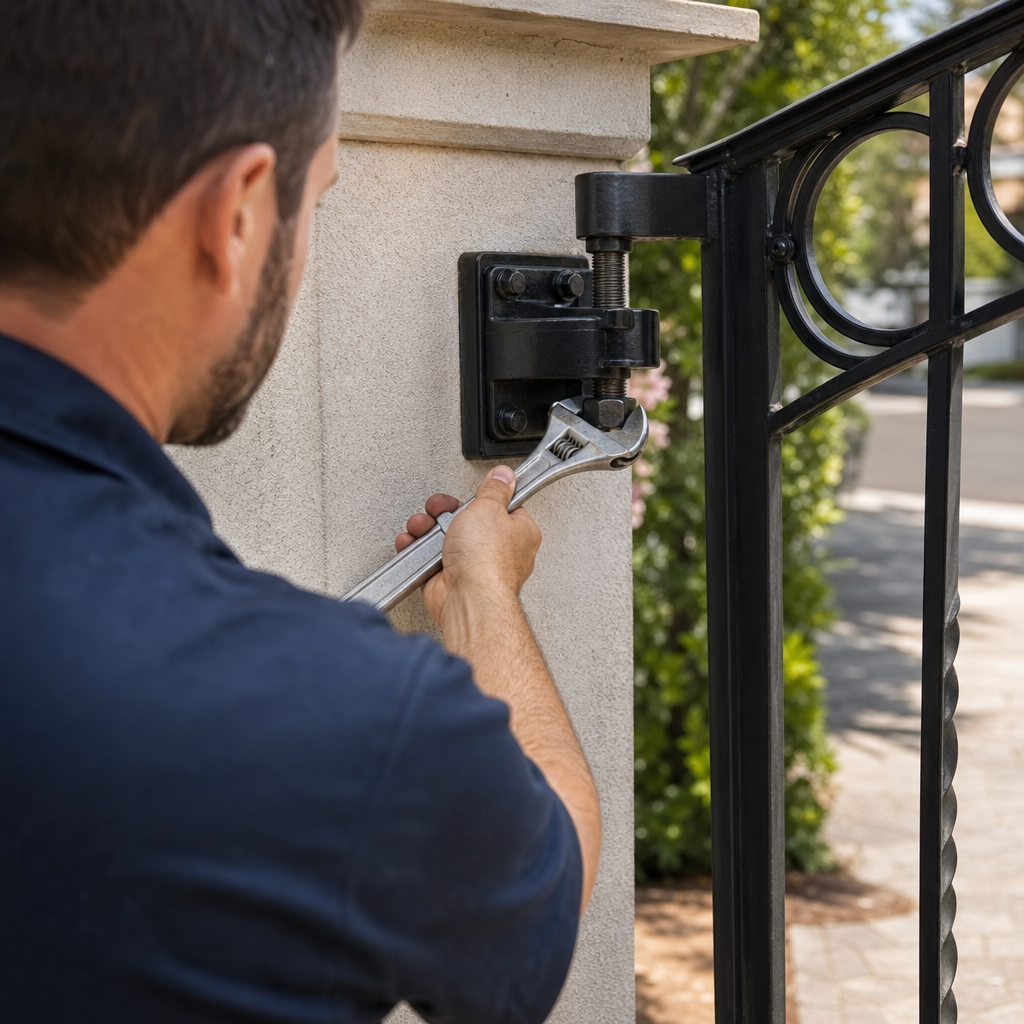
Turnbuckle anti-sag kits and support wheels are common DIY solutions for light wooden fences, but they can create mechanical issues when installed on heavy, automated driveway gates. They fail to fix post lean and often transfer road vibrations straight into the opener drive system.
| Feature | Cable Turnbuckle | Caster Helper Wheel | Structural Realignment |
|---|---|---|---|
| Heavy Iron Support | Stretches under load | Unstable on slopes | Structural steel reinforcement |
| Opener Protection | Poor load balance | High vibration shock | Minimal excess motor drag |
| Longevity | Temporary fix | Temporary fix | Long-term structural stability |
Cable Turnbuckle Kits on Heavy Wrought Iron
A turnbuckle kit uses diagonal tension to pull a sagging corner back upward. While this works on lightweight wood panels, the high deadweight of a solid steel or wrought-iron driveway gate can stretch the braided cable or bend mounting brackets. Heavy metal gates require rigid structural support, re-welding, and plumb posts to hold their shape.
How Gate Support Wheels Strain Gate Operators and Motors
Installing a spring-loaded caster wheel beneath the outer edge of a heavy swing gate can cause damage to automatic openers. As the wheel rolls over textured concrete, driveway cracks, or slope transitions, it bounces. That sudden vertical resistance binds the swing arm, triggering built-in obstruction sensors and requiring manual motor resets.
Preventing Motor Gearbox and Control Board Burnout
When an automated gate drags along the ground or fights a caster wheel, the opener motor draws significantly higher electrical current to force the gate open. This sustained load wears out internal gears, motor brushes, and primary control boards. Rebuilding the hinge assembly and plumbing the post ensures the motor moves free-swinging weight.
Key Components Serviced to Restore Level Gate Operation
Restoring a sagging gate requires correcting worn pivot points, reinforcing structural uprights, and recalibrating opener linkage to ensure a smooth, level swing path.
Heavy-Duty Adjustable J-Bolt and Ball-Bearing Hinges
When repairing a sagging metal gate, replacing worn hardware with sealed ball-bearing hinges or heavy-duty adjustable J-bolts can improve performance. Ball-bearing hinges lower rotational friction, reduce squealing, and allow fine adjustments if the property settles over time.
Structural Post Reinforcement, Re-Anchoring, and Welding
If a hinge post is leaning due to wind fatigue or a cracked base, total demolition of surrounding concrete is not always necessary. Technicians can reinforce the existing post, anchor it structurally into the footing, and reweld the assembly to restore load-bearing strength while keeping surrounding hardscaping intact.
Gate Operator Linkage and Limit Switch Recalibration
Once the gate hangs plumb and swings freely by hand, the operator linkage must be realigned. Technicians adjust the mechanical arm geometry, reset open and close limit switches, and test safety photocells across major opener brands.
What Does Fixing a Sagging Gate Cost?
Estimated costs for fixing a sagging gate vary widely depending on the extent of hinge re-welding, hardware replacement, and structural post realignment needed. If chronic frame drag has strained or damaged an automatic opener, secondary drive repairs can add to the total cost. Addressing hinge droop early helps avoid major motor failure down the line.
Driveway Gate Repair Service Considerations
| Service Type | Cost Factors |
|---|---|
| Diagnostic Inspection & Assessment | Site accessibility and gate system complexity |
| Hinge Realignment / Structural Welding | Hinge type, leaf weight, and welding scope |
| Track & Roller Realignment | Track condition, ground grade, and hardware wear |
| Opener Motor & Gearbox Repair | Motor type, internal component wear, and labor |
| Complete Automatic Opener Replacement | Operator brand, horsepower, and power requirements |
Note: Exact costs depend on gate dimensions, weight, and post foundation conditions. Request an on-site evaluation for precise pricing.
Repair vs Replacement Cost Tradeoffs
Restoring structural hinge alignment and reinforcing the post foundation can provide substantial savings compared to complete gate replacement. Heavy wrought-iron frames often have durable steel that is well worth preserving. Rebuilding the hinge connection and realigning the post addresses the physical problem without the high cost of custom fabrication. Ironworks Gate Co. provides clear written pricing before work begins. Call (747) 277-8422 to discuss service options.
Frequently Asked Questions About Sagging Gate Repair
Sagging gate repair corrects frame drag, straightens leaning posts, and protects your automated opener system. Taking care of hinge wear and post deflection early keeps your property secure and avoids unnecessary replacements.
How much does sagging gate repair cost?
Costs depend on whether the gate requires minor hinge adjustments, weld repairs, post reinforcement, or opener motor service. Ironworks Gate Co. provides on-site evaluations with upfront written quotes.
How quickly can a technician repair a gate dragging on the driveway?
The company states that technicians aim to complete most sagging gate realignments and hinge repairs in a single service visit, working to restore driveway operation on the same day.
Can a sagging gate be fixed without replacing the entire post?
Yes. Depending on the condition of the foundation, existing posts can often be straightened, sleeved, or reinforced with structural brackets without excavating the entire concrete base.
Are your repair technicians qualified to work on automated gates?
Yes. Work is performed by experienced gate technicians equipped to handle both structural iron repairs and automated gate operator adjustments. If your gate is scraping the ground, sticking, or overloading your automatic opener, contact Ironworks Gate Co. at (747) 277-8422 for service assistance.
Sources
- AB 2149 (Connolly) – sjud.senate.ca.gov (2024)
- [PDF] 2024-11-20-COPF-CODD-Hummingbird-Alliance-Meeting-Log.pdf – cpsc.gov (2024)
Related reading: Electric Gate Troubleshooting | 10% Off & Free Estimate | Same-Day Service
Related reading: Automatic Driveway Gate Repair – Call Now-10% Off – On-Site in 60 Minutes – Free Estimate
Related reading: Electric Gate Problems – Call Now-10% Off – Same-Day Service – Free Estimate
Frequently Asked Questions
How can I tell if a sagging gate is caused by worn hinges or a shifting post footing?
Place a four-foot level against two adjacent sides of the hinge post; if the post is plumb, the sag is usually caused by worn hinge pins, degraded internal bearings, or cracked weld points. If the post tilts outward under the gate's weight, subsurface ground settling or wind stress has compromised the post footing. Ironworks Gate Co. inspects both pivot hardware and sub-grade post stability to determine the exact mechanical repair needed.
Will letting a sagging gate drag damage my automatic gate opener?
Yes, continuous physical resistance forces the gate operator to draw excess electrical current, which rapidly wears down internal gearboxes, motor brushes, and sensitive control boards. Dragging leaves can also misalign mechanical travel limits and cause safety sensors to trigger false obstruction stalls. Restoring level swing clearance eliminates motor strain before an expensive drive replacement becomes necessary.
Why shouldn't I use a caster wheel or turnbuckle kit to fix a sagging metal gate?
Turnbuckle cables easily stretch under the deadweight of heavy iron, while caster wheels bounce over driveway transitions and transfer harsh shock vibrations into the opener arm. These surface-level modifications fail to address post deflection or metal fatigue at the foundation. Ironworks Gate Co. provides lasting stability by welding heavy-duty sealed ball-bearing hinges and structurally reinforcing the existing steel post.
About the author
 |
Sarah Miller Sarah is a seasoned technical writer with over 8 years of experience in the home services industry, specifically focusing on automated gate systems and property access control. She holds a B.A. in Communications from California State University, Fullerton, and works closely with licensed technicians to translate complex mechanical and electrical repair processes into accessible, transparent guides for homeowners and property managers. Her expertise lies in breaking down gate repair costs and maintenance best practices for Southern California residents. |
Gate not opening, off track, or opener dead?
We’re available now - call for a fast, free estimate.
Call Now - Free Estimate